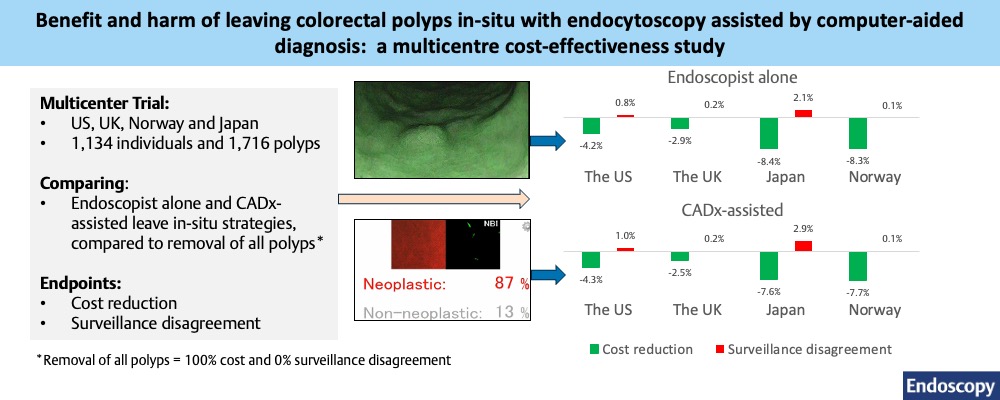
This week, the paper “Benefit and harm of leaving colorectal polyps in-situ with endocytoscopy assisted by computer-aided diagnosis: a multicentre cost-effectiveness study” was published in Endoscopy, the flagship journal of the European Society of Gastrointestinal Endoscopy (ESGE). The first author is PhD fellow Natalie Halvorsen at the Clinical Effectiveness Research Group, at the University of Oslo. The project was conducted in collaboration with leading international researchers, and it investigates the effect on patients and healthcare when artificial intelligence (AI) is used when performing visual diagnoses during colonoscopy. The publication is developed using insights generated by the EndoBrain International study.
Reducing unnecessary procedures
The main findings of the project were that compared to removing and sending all lesions for assessment, both visual diagnosis by a clinician, with and without AI, can reduce overtreatment and costs without significantly risking mismanagement of patients.
The use of AI can benefit patients by reducing the number of unnecessary removals of lesions in the colon (overtreatment), but it may also risk increasing the possibility of misdiagnosing lesions (mismanagement). For the healthcare industry, AI can reduce costs related to colonoscopy by decreasing the volume of treatments and histopathological analyses. However, it may also increase costs due to expenses associated with the use and updating of the AI tools.
– Although AI-assisted endoscopy shows great potential, further research is necessary to ensure patient safety, says first author Halvorsen.
– The findings will be included in ongoing discussions and evaluations that may shape guidelines for the use of artificial intelligence in colon examinations.