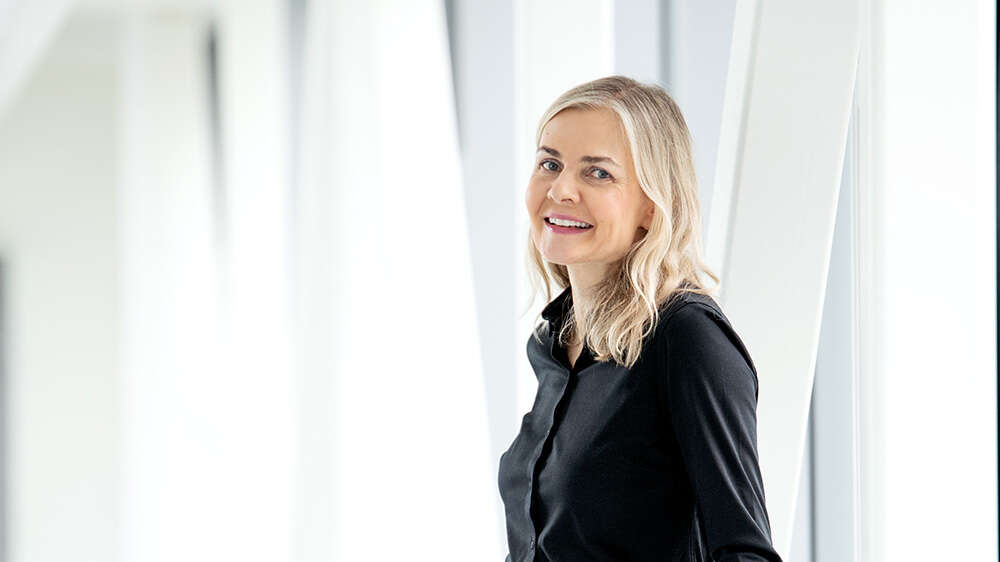
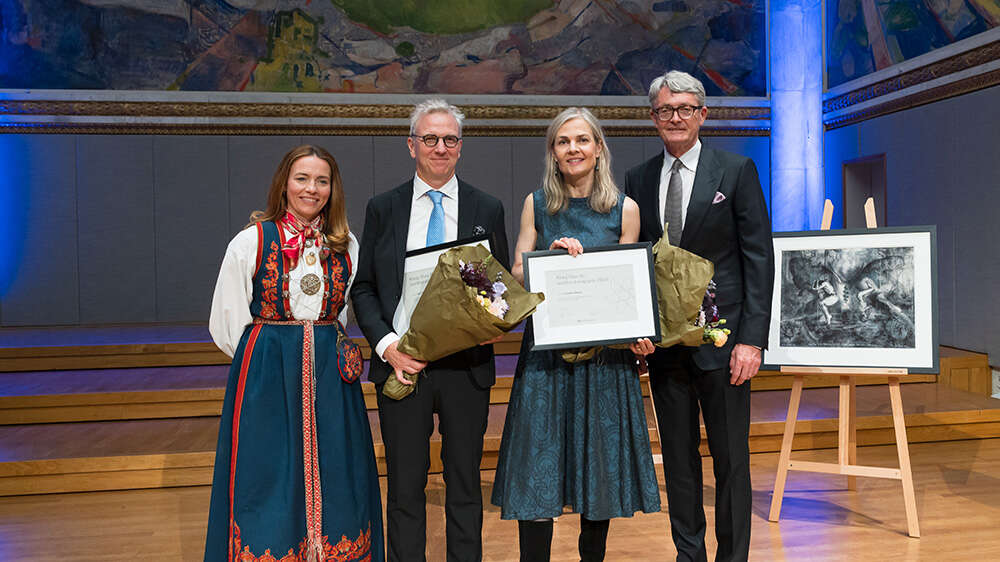
The prestigious prize was presented by H.M. King Harald during a stately ceremony in the University Hall in Oslo on Tuesday, May 19th.
“It's very nice, and of course a great honor. This is the largest cancer research prize in Norway, so it's grand,” Johanna Olweus says.
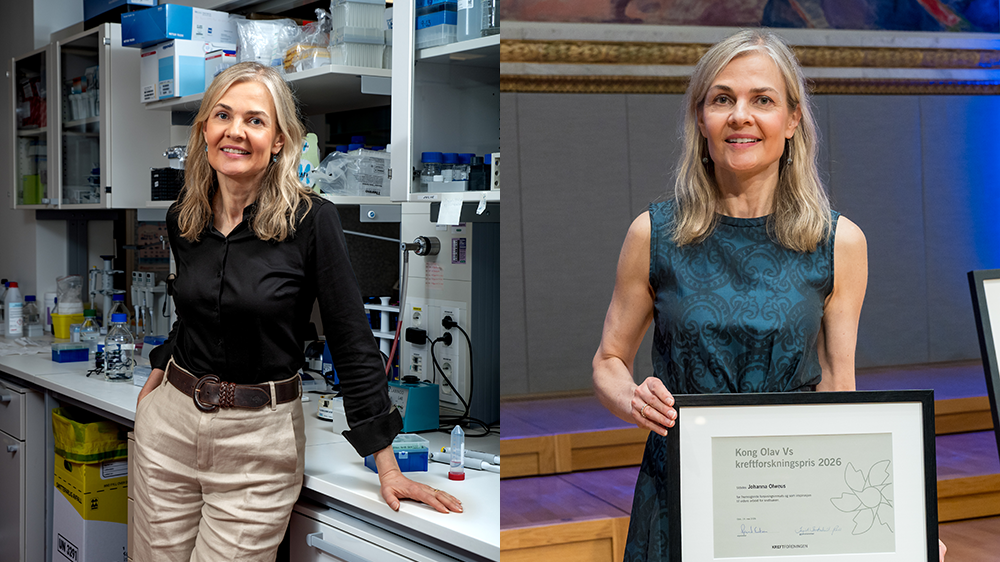
She is a professor at the University of Oslo, a research group leader at Oslo University Hospital (OUS), and, from summer onwards, she will lead PRIMA, a Centre of Excellence in precision immunotherapy, at UiO and OUS.
“The award is recognition of work over many years, involving many people. This is truly an award for the entire research group,” Olweus says.
Has pushed the boundaries of what is possible
Immunotherapy has revolutionized treatment for several types of cancer over the past 15 years. But many patients still are still not benefitting adequately from the treatment.
“Our goal is to improve the prognosis for these patients,” Olweus says.
Her research has made important contributions to the development of new forms of immunotherapy. The Secretary General at the Norwegian Cancer Society, Ingrid Stenstadvold Ross, describes Olweus as unique.
“Johanna Olweus has pushed the boundaries in one of the world's most competitive research fields. What makes her truly special is that she both delivers basic research at the highest international level and works purposefully to transfer discoveries all the way to patient treatment. We are incredibly proud to have researchers of Johanna's caliber in Norway,” she says.
What are good targets for cancer treatment?
For many years, Olweus and her research group have been working to exploit the ability of T cells to recognize and attack cancer cells.
“It has been indisputably proven that T cells, a type of immune cell, can cure cancer. These are the same T cells that cure us of infections such as influenza. So, if we can target T cells against cancer cells, they can be very effective,” she says.
A central part of her research revolves around finding the exact targets on the cancer cells that the T cells should attack.
“Cancer cells are 99 percent alike normal cells. We need to find the "Achilles heel", what really distinguishes cancer cells from healthy cells. Then we can target the T cells there,” she says.
Using healthy blood donors to fight cancer
A breakthrough for the research group happened through the development of a method that uses T cells from healthy blood donors to recognize and kill cancer cells far more effectively than the patient's own T cells can. This study was published in the renowned journal Science in 2016.
“When cancer develops, it often grows slowly and silently. The immune system does not receive the powerful danger signals that we get with, for example, influenza,” Olweus says.
Over time, the patient's immune system can adapt to the cancer. The T cells become exhausted in their attempt to fight the cancer, or they learn to tolerate the changes from the cancer cells.
“These are mechanisms that a healthy blood donor has not been exposed to. Therefore, immune cells from healthy people can be better at recognizing cancer cells. By extracting and copying T cell receptors from healthy donors, we can reprogram the patient's own T cells to recognize the cancer cells better,” she explains.
Inspired by organ transplant patients
Parallel with this, Olweus has been working on another, exciting idea: Using mechanisms from the rejection of transplanted organs as a basis for new cancer treatment.
Early in her career, she noticed something special in organ transplant patients. They must take lifelong immunosuppressive medications, which prevent the T cells from rejecting the foreign organ. Rarely, the patient develops cancer in the transplanted organ.
“In many cases, it works to simply stop the medications. Then the patient's T cells will reject the cancer, but also the transplanted organ. The interesting thing is that in such a situation, the T cells can also reject cancer that has spread outside the transplanted organ,” she says.
She discussed this with her husband, researcher and partner in PRIMA, Fridtjof Lund-Johansen.
“Could we use the extremely powerful immune response to target only the cancer cells?”
From an idea that few believed in to treatment that is tested on patients
She says that many were skeptical and thought this was too radical of an idea. They struggled for a long time, both in relation to getting funding for the project and in relation to publishing articles, before their first proper article was finally published in a little-known journal. Over time, the breakthroughs arrived, with an article in Nature Biotechnology in 2022 as a highlight.
“It was only then that we gained true traction and visibility for this concept,” she says.
The treatment will now be tested in a clinical study at Oslo University Hospital, and the first patients will be included in the study in 2026. The initial goal is to show that the treatment is safe.
“It is one thing to publish good academic work. A completely different, but at least equally demanding part, is to take a self-developed treatment all the way to the clinic. There was no infrastructure for this in Norway, so we have had to build up a lot ourselves. The fact that we are now on the threshold of testing the treatment on patients is incredibly motivating,” she says.
Wanted to use the immune system against cancer
Olweus describes herself as “hereditarily burdened” with an interest in research.
“My father was a researcher, and I always got the impression that it was the most fun and exciting thing you could do,” she says.
Already during medical school, she was drawn into laboratory research, and took a leave of absence to do research. After her studies, she went to the United States when her husband got a postdoctoral position.
“One year turned into almost five, and this stay was incredibly important for both of us in terms of the direction our research took, and for everything we experienced privately. I wish more young Norwegian researchers would take the chance to go abroad,” she says.
When she started specializing in immunology and transfusion medicine, her direction was clear.
“I became more and more interested in how the immune system could be used in cancer treatment,” she says.
An important turning point was the meeting with Head of Department Erik Thorsby.
“He was keen to recruit doctors who wanted to do research, and opened the door for me to build my own laboratory. That kind of support early in my career has been crucial.”
Built a strong research team
That is why Olweus is proud of the research group she has built.
“I am proud to have built a very strong research team and a large international network. I have done this without being the “heir” to an established group, and it was difficult at first. I am grateful to the talented researchers who were the first to dare to invest in my projects when there was still much that had not been proven, among them Erlend Strønen, who was the first author on the Science article in 2016,” she says.
“I was also touched by the families of cancer patients who believed in me and raised money for my research in an early phase. One of the families even organized a rock concert to raise money for my research, and invited my entire family! That was a powerful experience.”
International collaboration and good technology crucial for success
International collaboration is absolutely crucial for success, according to this year's prize winner.
“In a small country like Norway, it has enormous value to have good international networks, complementary partners, and access to the best technology,” Olweus says.
She points out that modern research is largely governed by the technological tools you have at your disposal, and that this is often underestimated, especially in Norwegian research.
“The technology you have sets the limits for what you can discover and study. Access to the best technology, and people who develop new technology, is absolutely central. New technology has given us quantum leaps in much medical research,” she explains.
Good infrastructure and support from UiO and OUS
Artificial intelligence also plays a role in research, but Olweus emphasizes that artificial intelligence is only as good as the data it is fed.
“It is extremely important to understand that you need large, well-validated data sets. There is a lot of “crappy” data that goes into AI, and then you also get crap out,” she says.
High ambitions need both strong international networks and solid local infrastructure.
“It is incredibly important to have good core facilities in terms of access to good technology. So having good infrastructure at the hospital and the university is very important for our research. We have great working conditions at the Institute for Cancer Research, and the support from both UiO and OUS has been central to everything we have achieved,” she says.
The creative process makes the job exciting
For Olweus, the creative process in research is an important driving force.
“What I like most about my job is the creative process. The process of getting an idea, discussing and developing it further, and sometimes seeing that it is right. Or discovering something completely different along the way, which turns out to be just as exciting,” she says.
Many of the ideas arise in informal discussions within the group or at home with her husband.
“We discuss one thing, and then it ends with a new hypothesis or a new project. The group meetings are the highlight of the work week, the discussion is loud and the laughter is unbridled. It is incredibly inspiring,” she says.
But the goal is weighty: to be able to give cancer patients a better outlook.
“When I was a medical student, meeting patients with no hope of curative treatment made a huge impression on me. Since then, it has been a dream of mine to be able to develop a new treatment that allows you to bring this hope back,” she concludes.