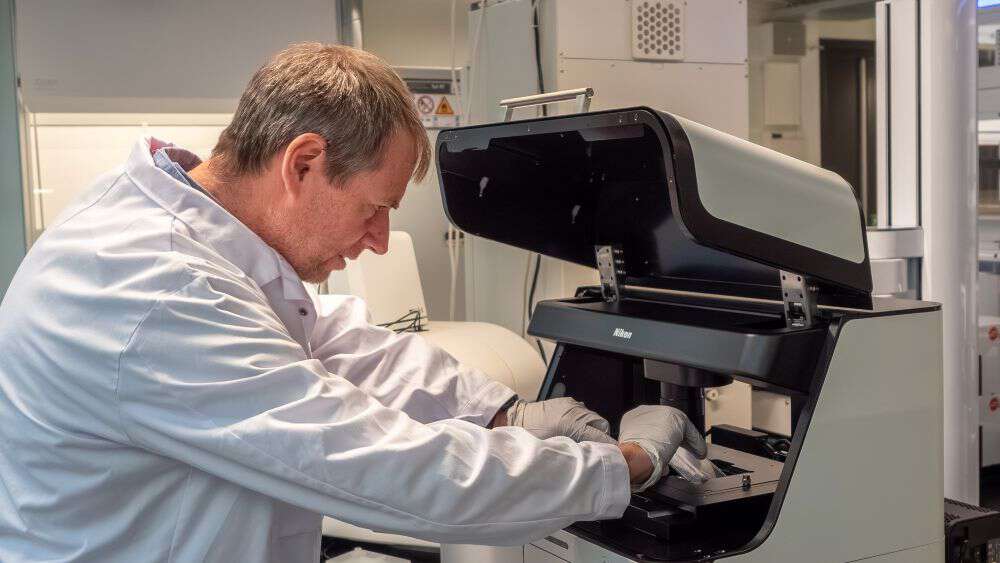
The High Throughput Screening Facility at NCMBM provides services ranging from assay development to automated screening and advanced data analysis. We support research in drug development, personalised medicine and the investigation of molecular and cellular mechanisms.
We have a compound library of approximately 75,000 small molecules includes cancer-relevant libraries, approved drugs for drug repurposing and chemical diversity collections.
We have a new Cell Painting platform that combines high-content imaging with advanced image analysis to generate high-dimensional profiles of cell morphology. Moving beyond simple dead-or-alive readouts, Cell Painting enables researchers to characterise complex cellular phenotypes and investigate potential mechanisms of action.
An interdisciplinary team of scientists with expertise in molecular biology, organic chemistry, structural biology and bioinformatics supports projects from initial study design and assay optimisation to image analysis and data interpretation.
Our team consists of four scientists with diverse backgrounds (molecular biology, organic chemistry, structural biology and bioinformatics) which enables us to deliver a comprehensive service portfolio from method development and high throughput screening to data collection and analysis.
What can your research group and the core facility contribute to, and gain from, the life sciences initiative?
Our facility can contribute to several areas of the life sciences initiative, including drug development, personalised medicine, antimicrobial resistance, and the study of molecular and cellular mechanisms.
We provide a comprehensive range of services, from access to instrumentation and automated liquid handling to large-scale high-throughput screening of up to 100,000 compounds. Our Cell Painting platform will further expand these capabilities by enabling researchers to investigate complex cellular phenotypes using high-content imaging and advanced data analysis.
We look forward to becoming part of an integrated research environment where expertise, technologies and infrastructure are shared across disciplines, creating new opportunities for collaboration and technology development.
What are you most looking forward to about conducting research in the new Life Sciences Building?
The move to the Life Sciences Building brings significant upgrades to our facility’s instrumentation and technology, including high-content imaging for Cell Painting. This will enable us to explore complex cellular phenotypes in greater detail and expand the range of questions we can address through high-throughput screening.
With automated workflows, advanced image-analysis pipelines and access to a diverse compound library, we will be able to tailor screening approaches to specific research questions. We are also looking forward to being closer to our users and other core facilities, creating new opportunities to collaborate, develop technologies and translate these capabilities into services that benefit the wider research community.
Which resources and facilities are most relevant for you to make use of?
High throughput screening is interdisciplinary and integrates many different fields and technologies, including biochemistry, cell biology, imaging, structural biology, mass spectrometry, bioinformatics and more.
We are looking forward to being collocated with the respective core facilities in the new building will and aim to develop new technologies and services together with them for our users.
What new opportunities for research collaboration do you foresee?
Besides collocation with the other core facilities, the new Life Science Building will also bring us closer to our users. We have just moved from Forskningsparken, where we were relatively isolated from our user community. Our recent move will enable much closer interaction with our users and make it easier to attract new groups.
Do you already collaborate with other groups at UiO/OUS? If so, which ones?
Annually, we run approx. 20 projects of which some are on a national or international level, but most are with users located in Oslo. This includes users from the University of Oslo (Faculties of Medicine and of Mathematics and Natural Sciences), as well as Oslo University Hospital (Montebello and Ullevål), and some smaller companies.
Life Science at the University of Oslo include activities within the areas of biosciences, pharmacy, chemistry, medicine and odontology. Many of these are gathered under the same roof in the Life Science Building.