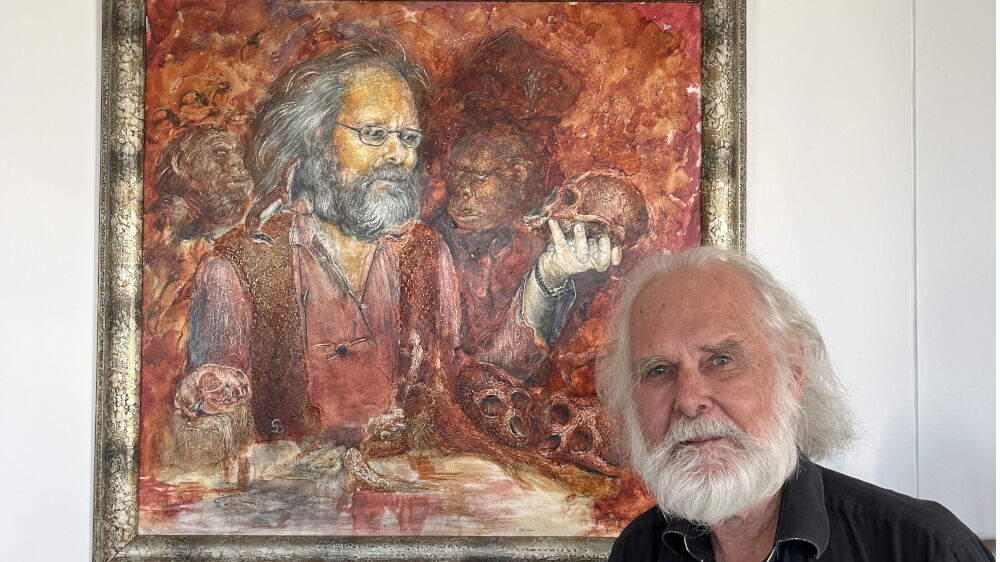
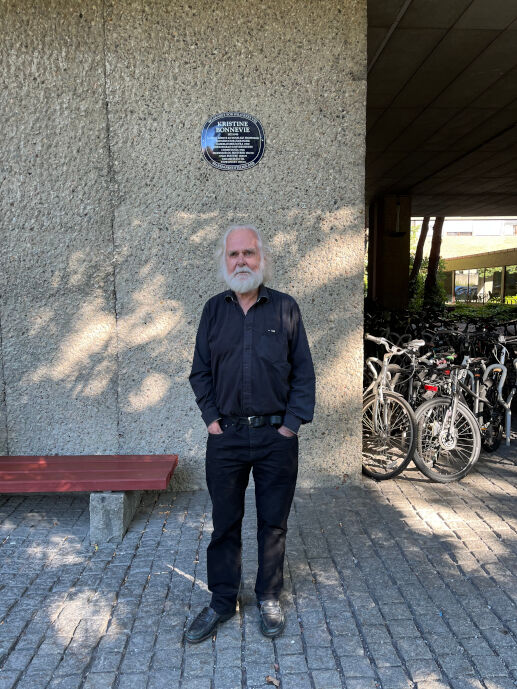
Nils Christian Stenseth is vice-leader of the Centre of Pandemics-and One-Health Research and Professor of Ecology and Evolutionary biology. When asked to give a short introduction to his academic background, the story starts back in 1968, and it is clear that this is not a short story to tell. Nils Christian is an ecologist, evolutionary biologist, and has been at the Kristine Bonnevies Hus, as long as it has been there. For Nils Christian, what is most important is that the work is solid, whereas usefulness may come in second place.
As long a tenure as the age of the building
For a long time, Nils Christian studied and worked at the University of Oslo.
"I started here in 1968, and I started working on lemmings, partly here in Norway, at Finse, and partly in the US at Point Barrow. I had my first scientific paper in 1974 on lemmings. I did not do a master's degree, but I did a D. philos. In 1978 I defended my thesis, and then I moved to the University of Lund. I was there for a couple of years, commuting a little bit back and forth."
He always found his way back to the University of Oslo. In 1980 he was appointed Associate Professor in population biology. He has worked on a broad spectrum of topics, including the Red Queen evolutionary theory:
"In order to stay alive as a species, you have to evolve as fast as you possibly can. Similarly, species will have to evolve all the time in order not to go extinct."
After many years researching population biology, Nils Christian was interested in finding something new to work on. He was proud of the work he had done on how climate variation was affecting ecology, but wanted to work on something conceptually new.
"So I went around to people and I said, 'I would like to study the disease system'. I wanted to study a disease system among humans, which in order to understand the dynamics across space and time within the affected human populations, one would have to understand – and study – the dynamics of the pathogen out in nature."
A good friend of Nils Christian reached out to him and asked him to collaborate with a group of people from Kazakhstan and the neighbouring countries. He asked Nils Christian to join them in this research and attempted to attract Nils Christian by telling about their interesting Asian data on Yersinia pestis, the bacterium causing plague among people.
"I said, thank you very much for thinking about me, but I really have too many other things to do. I can't really do it. If I start a new project now, I might go crazy."
The following year, Nils received another call. The same friend asked him to come join the research again - but Nils Christian again declined. However, the friend rang up again with an offer Nils could not refuse:
" 'Nils, I'm sure you're going to a dinner tomorrow night. Why don't you take that dinner in Copenhagen?' And I did travel to Copenhagen. During that dinner, I essentially became project leader of a Yersinia pestis/plague project in Kazakhstan."
A life about plague
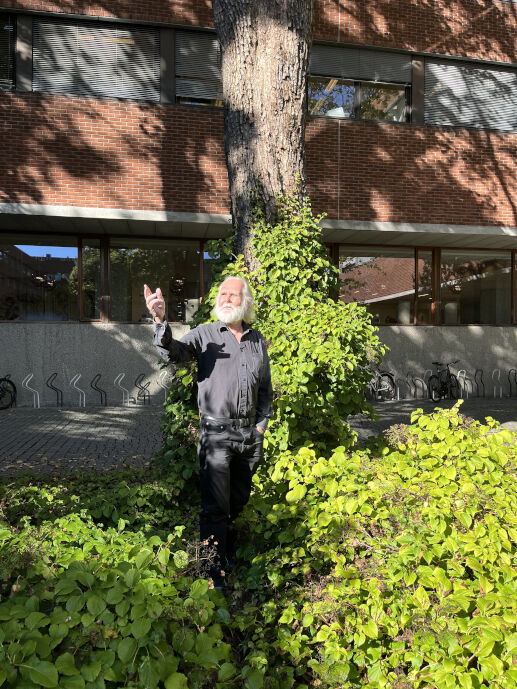
Nils Christian tells enthusiastically about the plague and the bacterium causing it. He tells us about the history of plague, the different versions and about the first research on it.
"Plague is caused by a bacterium called Yersinia pestis. Human plague comes in different forms, partly bubonic and partly pneumonic."
It is important to get to a doctor as soon as possible if you have the plague. Nils Christian gives a person four days, and if the person has not been to the doctor to get treatment - they are dead. Plague is transmitted in different ways. The bubonic form is spread between people through fleas. The bubonic form can also transform in the body, and develop in the lungs. This pneumonic form can transmit through droplets.
"It is a very deadly disease. During the Black Death, half of the human European population died in a couple of years. COVID-19 is nothing in comparison. 50% of the human population, more so in Southern Europe and less so in Northern Europe. 50% on average."
The research conducted by Nils Christian has been revolutionary in looking at plague from a perspective other than a public health problem. There are still a lot of unknowns regarding plague. It is an old disease that is still occurring today, and in order to understand history, we need to understand why so many people died.
Nils Christian has searched for linkages between climate variations in Central Asia, and the occurrence of plague in Europe. When there are good plague conditions in Central Asia, you can find plague in Europe about ten years later. The plague found in nature and in wildlife spills over to the human population when the rodent host populations crash - just like lemming crashes after peak lemming years. In order to understand the history, we need to better understand the spill over from nature to humans.
The Synergy Plague
"I would describe the Synergy Plague project with 'plague, history, and biology'. 'Plague' is a disease, caused by a pathogen. 'History' is really to study in archives and find reports from what has happened. And then 'biology' of different kinds, population biology, but really the whole spectrum of biology."
In 2022, there was a question about whether there was a long-term plague reservoir in Europe, and if there has ever been one. The answer to this was a clear “no”. Nils Christian took notice of the interest behind this question and established the Synergy Plague project.
"We should understand the biology of this disease in order to understand the human history."
To learn, it is important to know the history of what one is studying. As for plague, it changed history and the trajectory of it throughout Europe. Under Covid-19, we experienced a similar type of chaos in society as the experienced by societies under plague outbreaks.
"No one had heard about Zoom before, few had heard about Teams, but suddenly everybody used them. It changed history."
The research fits well within the theme of One Health. Nils Christian explains the term by linking ecologists working on pathogens in nature with people working with public health and with pathogens in people. In this way, it is easier to see the connection between nature and people, and how those components affect each other in infectious outbreaks.
"Our ambition at the Centre of Pandemic and One-Health research must be to make the definition and the understanding of infectious diseases and One-health better and more solid."
The ERC Synergy project is a One-Health project. The project is focused on an important disease in the past to improve our understanding of present and future threats. Climate is also a major factor when it comes to the spread of the disease. Periodically, there are epidemic disease outbreaks in different geographic areas of the world. With climate change, existing patterns may change, and some diseases may spread faster or new diseases may arise.
"A driver in my work has never ever been to be useful. But a driver has to do solid work. I am very happy if people find the work I am doing very useful."
Thank you to Nils Chr. for participating in this interview.