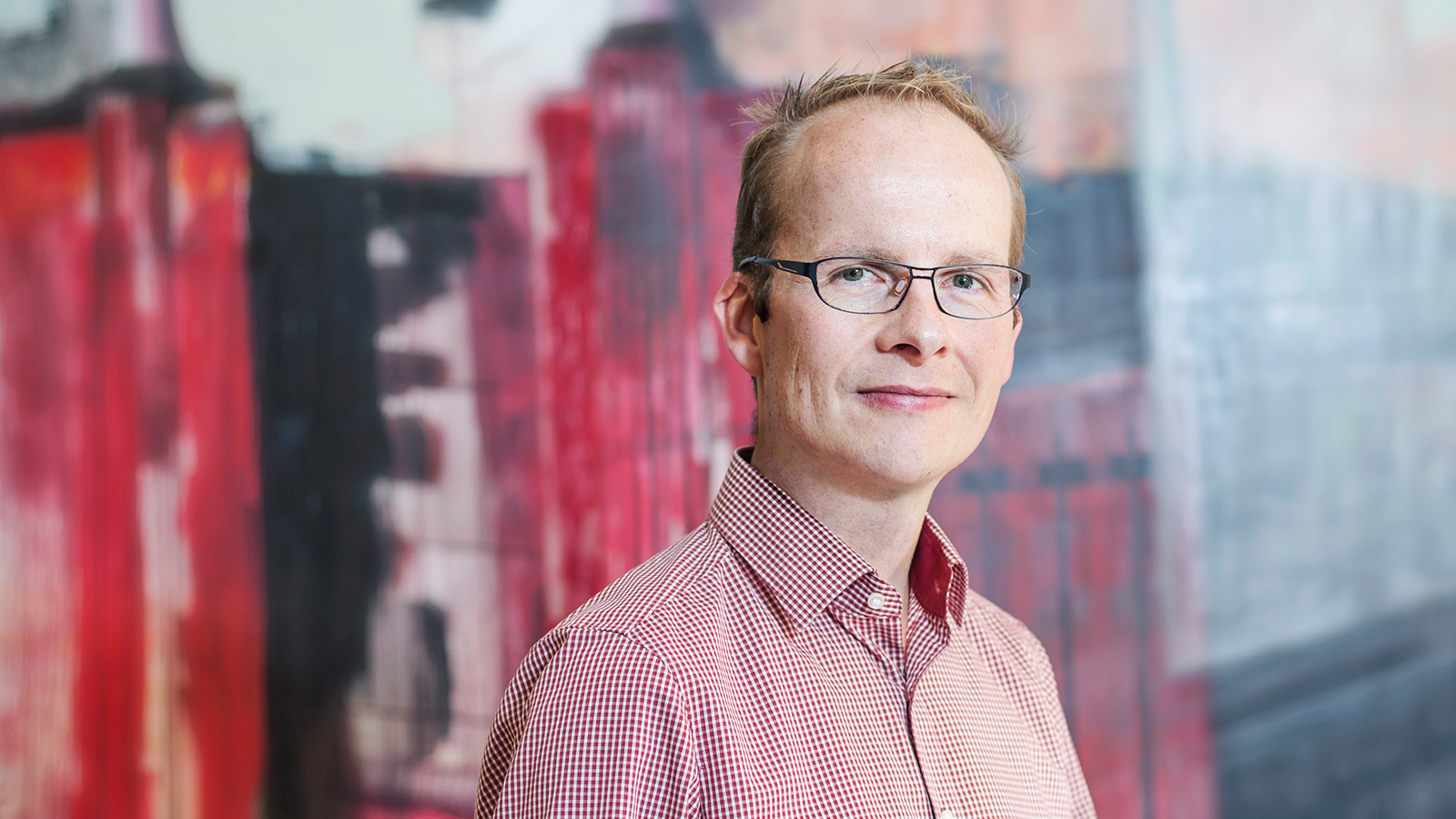
The Centre for Pandemics and One-health Research (P1H) aims to conduct a series of interviews, «P1H Coffee Break», with researchers to raise understanding and awareness regarding the field of pandemics and One-health.
How would you describe your research in three words?
I was about to say digital transformation of healthcare, but that's more than three. Then I thought about digital health, but that's only two. I will go with digital health innovation.
For the past decade or so I have been heavily involved in research at the intersection between healthcare and IT. I have been doing that in many different types of studies, both micro and macro studies.
I have an information systems background, so healthcare is something I have become involved in over my research career.
For the last decade I have been doing studies focused on very specific digital health interventions at a clinical level. That is what I call micro level. Those are e-Health studies. Lately I've been involved in
much larger macro level studies. Currently, I am at the Department of Informatics and affiliated with the Health Information Systems Programme. We are doing action research in low and middle income countries.
We are trying to deploy a health analytics platform that gives low and middle income countries decision support. By decision support, I mean for public health officials to get decision support in terms of how climate variability impacts human health.
What motivated you to do research on this topic? What brought you into healthcare informatics?
It seemed to be a more productive and meaningful use of my time, and it speaks to a personal motivation to help alleviate some of the societal problems that we are facing now and in the future. A fun fact is that I used to work for a defense company that was all about bullets and weaponry, and pivoting to healthcare seemed to be more in line with my personal values.
What is the aim of the research you are conducting?
The goal of my research is to help address this uneven burden on low- and middle-income countries of the impact of climate change on human health. For us here in the global north, in the Nordic countries, maybe we get a little warmer summers. Maybe we would get a few more extreme weather events, but we probably won't experience the same negative impacts, at least not for the foreseeable future, as many countries in the global south. These countries will experience a rise of vector-borne diseases and a lot of other things, more floods, failed crops, malnutrition, and so on and so forth.
Climate variability or climate change really have negative impacts on countries in the global south. I want to dedicate a substantial part of my research time to help address those problems. I can do that through informatics related research.
We have developed a new AI platform that gives public health officials the tools and the decision-making input that they need to plan ahead so they are not taken by surprise when all of a sudden there is a spike in, say, malaria or dengue fever or something else. They can actually see it coming and they can plan accordingly.
That is hopefully my small contribution to a very, very big problem.
Why do you think this topic is so important?
I think it is particularly important today. Now that we are experiencing a changing global political climate. I am especially thinking about the new policy signals from North America, where climate change is being debated in a negative manner. I honestly thought we had come to a consensus that climate change is a fact and it will have negative impacts. That consensus would push us to do our best to research and try to alleviate these problems, but it seems that we are backtracking.
With this political climate, we see a very unfortunate drop in funding to very important health programs globally. USAID is the prime example of this being cut from one day to the next. A lot of the countries that were dependent on that aid no longer can count on it, and they are struggling even more.
I think that makes the kind of research that we do here at the HISP Center all the more relevant.
How are your studies related to the One-Health concept or pandemic studies?
Essentially, we are looking at this from a planetary health perspective, and One Health is part of Planetary Health.
Down the road, we want to scale our efforts to encompass broader perspectives than just climate and climate variables and human health, but we have to start somewhere.
That is why we started with something that is very close to home, because our platform is used in more than 70 countries. It is called the DHIS2 platform, which is a health management information system that is focused on human health.
Together with all our partners, we started registering and using public health data.It was natural for us to start there and then try to integrate climate factors, climate variables, in trying to again predict the impact of climate variability on climate sensitive diseases in the countries that we work with, for example.
We want to broaden our perspective and we are also doing smaller research projects with some of our partners.
It is a study that is closely linked to One Health, that I did a couple of years back in Rwanda, which focused on antimicrobial resistance.
And we definitely do want to focus more on that. The study tried to predict three months ahead of time, what climate variability was going to do for different diseases - malaria.
It is super complex to integrate all the additional factors that would take us to a One Health perspective. We recognize the importance of One Health and planetary health perspectives, but we are also very humble about our capabilities currently. We have to start with what we have and what we believe we can get up and running, and then scale from there.
Are you collaborating with partners from all over the world?
Yes, we have a dedicated team here in Oslo. That is the central HISP UIO team, which is responsible for developing and maintaining the DHIS2 platform and the climate health analytics platform.
Out in the different countries, we have local HISP groups and they are our implementation partners. They work closely with public health officials, institutions, and governments to bring information support in all these different countries. We do not do that work. We believe that our partners are best suited for that. We try to listen to their needs and develop the tools that they need, and then we take part in joint research efforts.
Each HISP center has their own specialty?
Yes, it is a complex setup. What we essentially do is that we contribute to what we call capacity building. We contribute to building local capacity, and we do that in different ways. We have an implementation team here, and they work closely with the developers. They lend support to the countries in terms of implementation of not only the platforms, but also integrating those platforms with other systems, importing data, local data into the platforms.
In addition to that, we have a research arm, and I am representative of that research arm. This is an information systems research group and we do studies together with our partners. I have several PhD students who work in these local HISP groups and I do research with them to identify problems and we try to solve those problems.
I just came back from a field trip in Uganda and next month I am going to Nepal for some additional field studies and that is all about learning from our partners what it takes to implement these tools in practice. Then I bring back that knowledge to inform the rest of the team here.
Is there anything you would like to add?
I appreciate the interdisciplinarity of the kind of research that we do.
We really do work across so many different domains.
It is everything from more classical healthcare, that could be in the sense of epidemiology, but then also public health. Then again, you got computer science and climatology. There are so many different areas of expertise we try to incorporate and bring to bear on these very large, existential problems. That makes it super exciting to be part of this journey, and to invite others from other fields to take part in these efforts.
Thank you to Sune for participating in this interview. Check out our Instagram at @pandemicscentre.uio to see snippets of the interview.