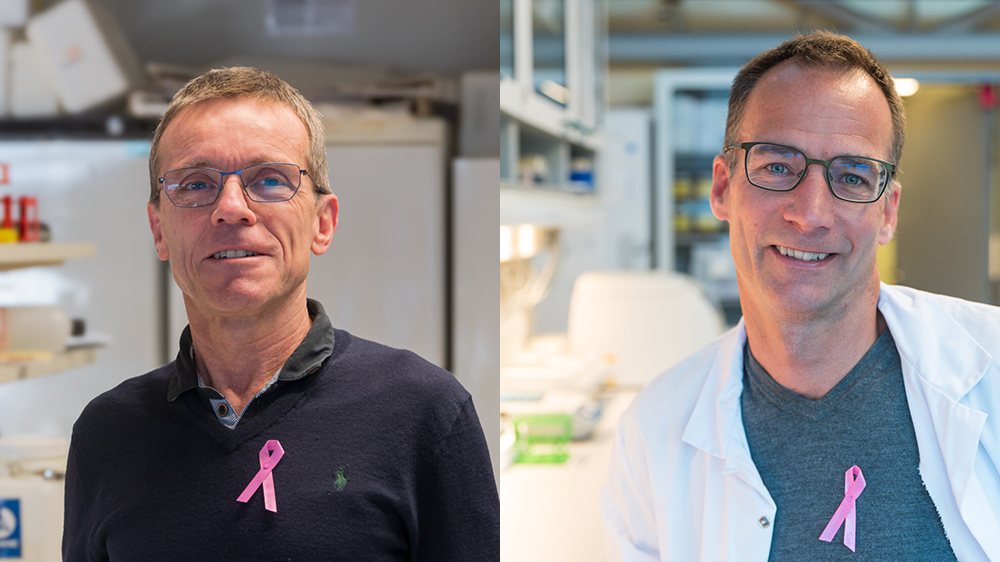
Collas’ group at the Department of Molecular Medicine at the University of Oslo will investigate whether a new type of transcription factor inhibitor can prevent breast and prostate cancer from spreading to bones, while Matthews’ group at the Department of Nutrition will examine how immunotherapy can be made more effective.
– Receiving this funding from the Pink Ribbon campaign represents a major recognition of our ongoing research to combat breast cancer and is a great motivation for our research group, says professor Philippe Collas.
– This funding is the result of an incredible effort made by countless individuals helping to promote breast cancer research. Receiving funds from the Pink Ribbon campaign means a lot to me and my team and makes it possible to conduct research that may lead to new treatments and better a prognosis for breast cancer patients, says professor Jason Matthews.
Plan to develop a new type of inhibitor to prevent cancer spreading
Breast cancer is the most common form of cancer among women.
– More than a million patients die every year in the USA and EU alone, from aggressive cancer that has spread to bones. In Norway, 600 people die of breast cancer annually, the majority because the disease has spread to other organs in the body, explains Collas.
He and his team will investigate how a transcription factor called RUNX2 contributes to breast cancer metastasis to bones.
– We will use the new findings to develop a new type of RUNX2 inhibitor, based on a class of molecules called microproteins, which can stop or slow down the spread of cancer cells, says Collas.
He hopes that this new treatment will have fewer side-effects than the current aggressive chemotherapy.
Why do the success rates of immunotherapy vary?
Some patients are currently treated with immunotherapy, especially those with inoperable cancer or whose cancer has spread to other parts of the body. This kind of therapy is designed to activate the patient’s own immune system so that it can identify and attack cancer cells, thereby slowing or stopping the growth of cancer cells.
Immunotherapy has very good outcomes in some patients, but not in others, says Professor Jason Matthews.
– So, nobody knows why this is so. We want to find out how to make immunotherapy more far effective, so that more patients can benefit from this type of treatment. We will investigate two proteins, PARP7 and PARP11. The actions of these proteins allow tumour cells to avoid immune surveillance and spread to other parts of the body, and this would suggest that inhibiting the activity of both proteins would reduce the ability of cancer cells to evade the body’s immune system.