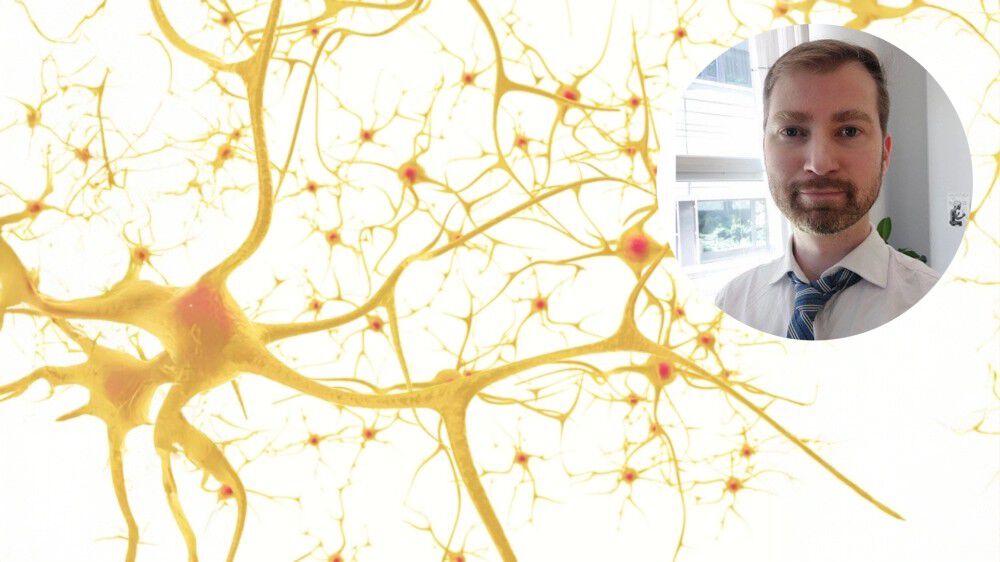
"I could hardly believe it; it’s absolutely fantastic news. This has been the project I’ve dreamed of," says a delighted Matthijs Dorst. The researcher was recently informed that he would receive 10 million kroner in FRIPRO funding for the project "The Role of Striatal Interneurons in Action Selection." This project will be located at the Department of Molecular Medicine at the Institute of Basic Medical Sciences.
Head of Institute Philippe Collas is very pleased.
"It’s an important grant for a great research environment. Many congratulations from the management at IMB," says Collas.
Researching how the brain makes decisions
Dorst elaborates on his research project: "When you stand in front of the door, how does your hand know to grasp the door handle? This is where the brain area known as the striatum comes into play. This part plays a crucial role when the brain is making decisions."
When you’re unsure of what to do—whether to move or stay still, to push or pull—it is the striatum that kicks into action. But how does the brain actually make these decisions? For many years, researchers have studied the brain cells that relay information from the striatum.
"Once the decision about what to do has been made, nerve cells send this information on to the rest of the brain, which ultimately controls our muscles. However, before it gets that far, the brain must evaluate all possible actions and choose the right one. A small group of what we call interneurons share information within the striatum. These nerve cells are important for determining the best course of action, but exactly how they do this has been a mystery to us," Dorst explains.
Important research for Parkinson’s disease
New opportunities have arisen through a completely new imaging technology that allows researchers to record the activity of specific interneurons in the striatum.
"This means that we can finally measure precisely what happens when we make a decision. In people with Parkinson's disease, the normal function of interneurons is disrupted. Understanding how these cells function in healthy individuals will be an important step towards understanding what goes wrong in those with Parkinson’s disease," says Dorst.