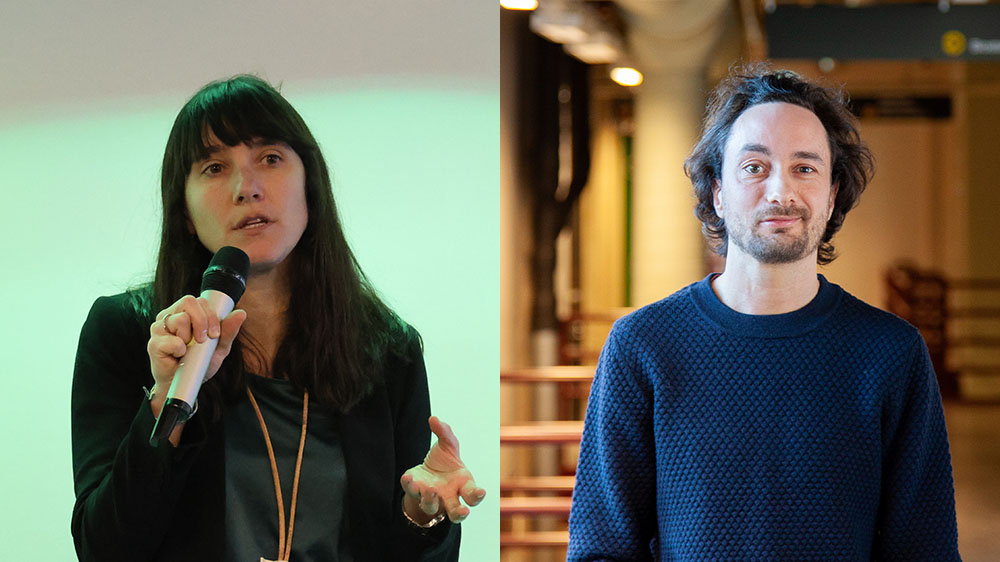
The two researchers at the Department of Biostatistics are very pleased about the award of FRIPRO funds from the Research Council of Norway.
Associate professor Valeria Vitelli has received 12 million kroner for developing statistical learning methods for data integration, which see the most important application in the context of cancer genomics. Staff scientist Harry Thorpe has been awarded 5.88 million kroner for a project to study antibiotic resistance, where he will be examining how plasmids evolve and spread.
The Head of the Institute, Philippe Collas is pleased with the news.
– Many congratulations to two of our expert researchers! These are both important areas of research and the award of these grants is very positive news for IMB, he says.
Basic research is crucial for developing and advancing methodology available to scientists
Vitelli explains how pleased she is for the recognition such a grant represents.
– Being awarded FRIPRO funds is essential for strengthening my research agenda and building up a strong research group. But in a broader perspective, this grant is also a clear recognition of how critical it is to finance basic research to further develop and advance the statistical methods that are available for use in science, she asserts.
Vitelli points out that statistics is the cornerstone of decision-making processes, and that modern data sources are becoming increasingly structured and complex to deal with. We therefore need advanced statistical methods and machine learning to keep up with these developments, especially in life sciences, she explains.
Difficult to classify and track plasmids
Harry Thorpe, on his side, explains that resistance to antibiotics is a serious threat to public health which is expected to worsen in the future. It has been estimated that 10 million people may die each year by 2050 from infections caused by resistant bacteria because of lack of treatment options.
One of the most common ways bacteria evolve resistance is by acquiring resistance genes.
– These are often carried on DNA molecules called plasmids, which evolve rapidly and can spread between different types of bacteria. For this reason, it is difficult to classify and track them, says Thorpe.
Advanced robust statistical models and computational methods for machine learning
Vitelli’s project, entitled BRIDGE, aims to develop statistical learning methods for data integration, to be used both in connection with molecular data, and to better understand user preferences.
– Today’s biomedical data are overwhelmingly large and complex, and statistical methods need to better understand and explain structure and dependencies in the data, explains Vitelli. –Developing methods that account for and quantify the uncertainties associated to results is also crucial, to ultimately take decisions in a more robust and transparent way.
– We will be working on advanced statistical models with solid mathematical bases and combine them with tools from modern computational machine learning methods. The final aim is to use these methods to develop tools that can be used directly in the clinics. This may involve, for example, better systems for recommending treatments, or better decisions tailored to the individual patient, says Vitelli.
Wants to study how plasmids evolve and spread
In Thorpe’s project, entitled PEAK, the researchers will be using sequencing technologies and developing new methods for examining how plasmids evolve and spread.
– We will be focusing on the important pathogenic bacterium Klebsiella pneumoniae. Our aim is to use the new methods and knowledge to improve surveillance, both of Klebsiella pneumoniae and other bacterial pathogens, he says.
Every year, many people fall ill due to the bacterium Klebsiella pneumoniae, and some of its variants are resistant to last-line antibiotic treatments. The World Health Organisation has therefore included Klebsiella pneumoniae on its priority pathogens list.
Many people have this bacterium in their intestines, without experiencing any adverse symptoms. But in other parts of the body, it can cause many types of infection: pneumonia, meningitis, urinary tract infections, and infections of the bloodstream and liver.
In a previous study, Thorpe and his research team discovered more about how these harmful variants are transmitted.