
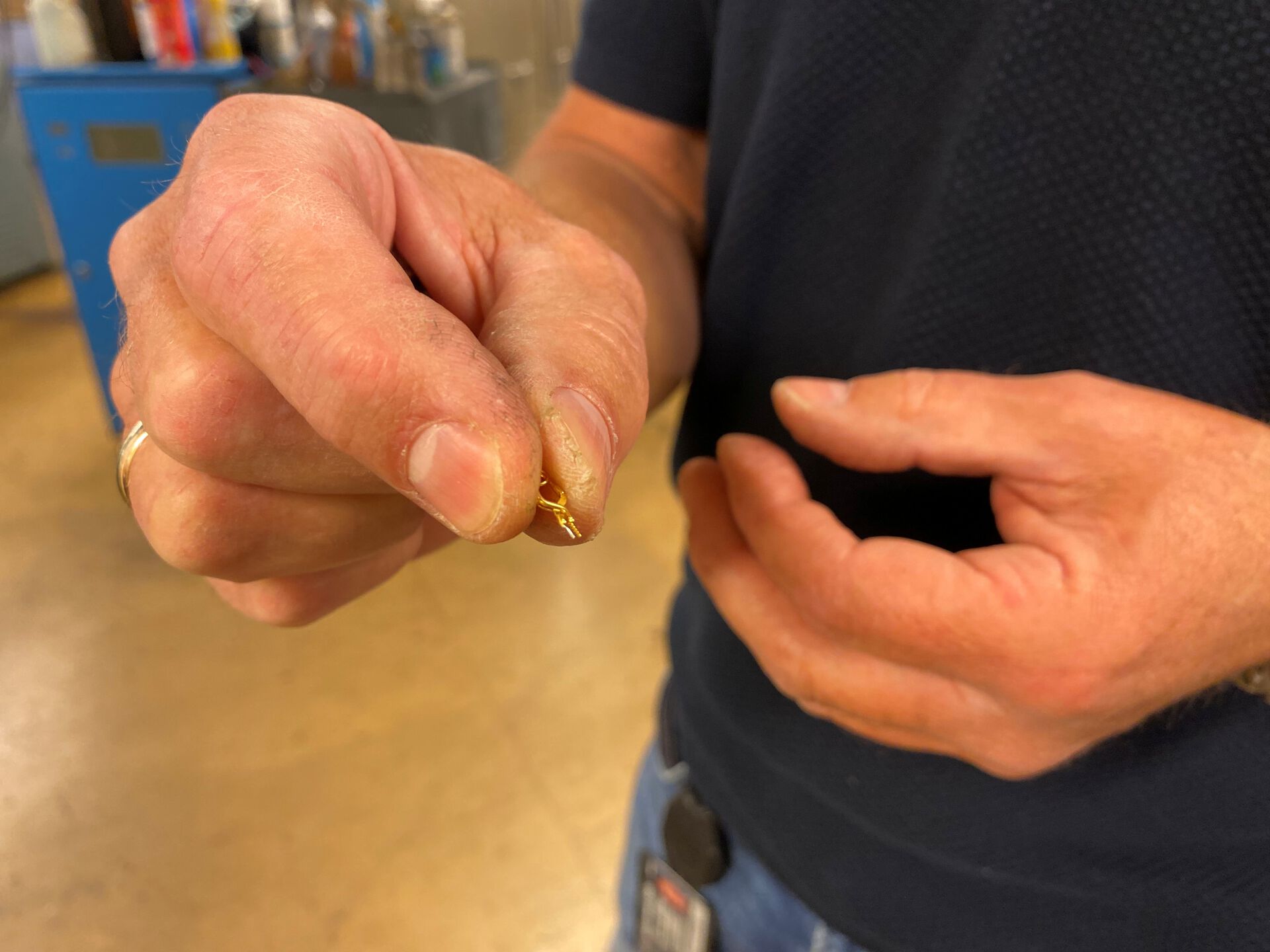
“This one couldn’t be ordered from anywhere. Look how small it is,” says head of department Knut Rekdahl at IMB’s mechanical workshop. He shows an extremely small clip they have modified so it can be used on the tiny blood vessels of mice.
“I don’t think we’ve ever told a researcher ‘we don’t know how to do that’. Nor have we said ‘we can’t help you with that’.” The workshop in the lower ground floor of Domus Medica has four employees and two precision-mechanic apprentices filling the role of fixer. They make equipment that either isn’t available on the market, or is required in such small quantities that ordering it commercially isn’t an option. Without them, many researchers would struggle to carry out their projects.
“At the moment we’re converting a retired 3D printer to create holes in precise positions in gel cubes. The cubes are used for stem-cell research. Previously the researchers had to make these holes by hand, and it was hard to get them exactly where they needed to be. Now the printer will be able to do this automatically and accurately,” says Rekdahl, who has worked in the workshop for more than 40 years.
The workshop saved a microscope worth 1.5 million
Further into the large room machines and equipment stand in rows. The fixers do milling, turning, 3D printing, welding, sheet metal work, surface treatment, soldering and grinding. More on that later.
The department also has someone who works with electronics. Recently he designed, in close collaboration with a colleague in the workshop, a device the researchers needed to cool mice. This had to be done in a controlled way and be repeatable.

The workshop doesn’t only make new things — they also repair equipment.
“A researcher brought in a microscope where two teeth on a rack had broken off. The rack enables the microscope to focus. The manufacturer told the researcher they no longer had a replacement part, so the 1.5 million kroner microscope would have to be written off. We soldered in a piece of brass rail and used a module milling cutter to get the teeth into the right shape. The microscope worked again, and we had a very happy researcher,” says Rekdahl.
The workshop keeps spare parts for later
The manager shows a room full of shelving metres and many small drawers from floor to ceiling. This is where they keep parts taken from decommissioned equipment that can suddenly become useful when the manufacturer says they no longer supply parts.

Rekdahl moves on to a large machine with a hatch.
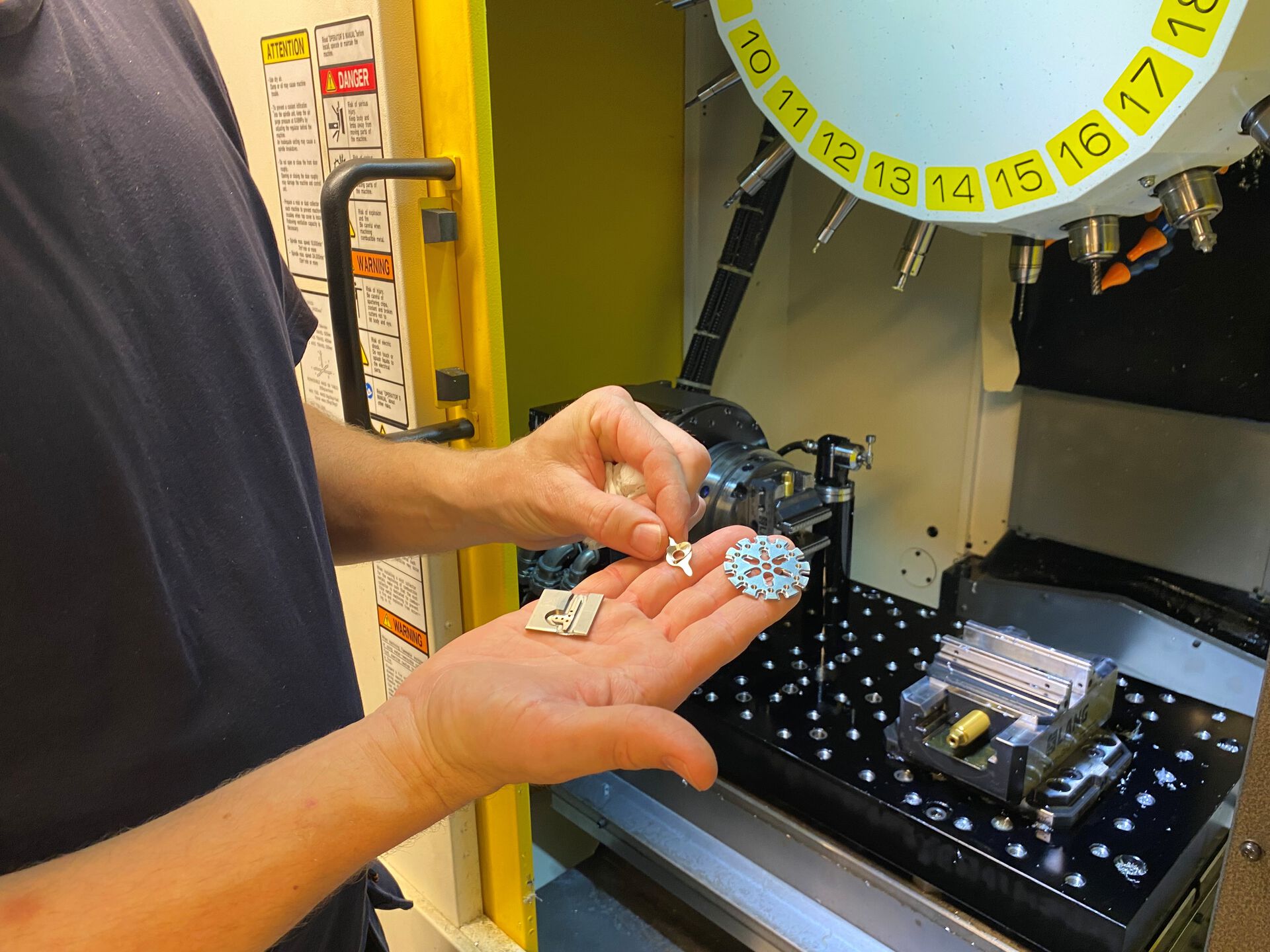
“This is a CNC milling machine. We design and draw the product we are going to make, create a CNC programme, transfer it to the machine and load the material we intend to use. Then the machine mills out what we need. We can use AI to generate technical drawings, but we must quality-assure them,” he explains.
Can act as consultants for users in the Life Science Building
Soon many researchers from the university and Oslo University Hospital will move into the new Life Science Building. Many of them may arrive with equipment that requires new solutions to make it function as it should. Perhaps fittings are missing that you can’t buy at Biltema. In addition to producing many parts and pieces of equipment, the workshop has a good overview of where parts and fittings can be sourced.
“Subject to capacity, we can take on consultancy tasks to find out where users can get what they need. We can develop bespoke solutions as long as we have the capacity. We prioritise users at IMB, but have occasionally taken on jobs from others, such as The National Hospital Rikshospitalet, the Faculty of Dentistry, Veritas and NIVA,” says Rekdahl.
The manager asks those interested to get in touch via the form on their website.
A price list is also available on their website (Norwegian).
Equipment can be tested and adjusted quickly
Rekdahl says the advantage for IMB’s researchers of having the workshop on site is the shorter time frame. Staff can receive an explanation from a researcher about what is needed, come up with a possible solution and make a prototype. The researchers can then test it and come straight downstairs to ask for adjustments. Often the prototype works so well that it becomes the finished product. The equipment can be tested and fine-tuned in a short time.
“If an external company had been in charge, it would have taken weeks with post and correspondence back and forth. The question is also how much it would have cost.” Rekdahl emphasises that the work they do can save the institute large expenses. Making equipment last longer also supports the University of Oslo’s sustainability goals.
Had to cut apart a meat grinder
The skills of the workshop staff are useful for other purposes too.
“Some years ago a senior physician at Rikshospitalet called. He knew of us because he had used us for some equipment before. A two-year-old had got the arm stuck in a meat grinder. They needed someone with fine-mechanical experience with aluminium to cut the grinder apart. One of the other doctors didn’t believe it would work, and said they should simply amputate the arm at the shoulder. We worked for one and a half hours and removed the grinder in four pieces,” the head of department recounts.
Afterwards they trained staff at Rikshospitalet to handle such situations themselves. “The story about the two-year-old actually had a good outcome. The surgeons worked microsurgically for five hours and managed to restore function to the arm and hand,” says Rekdahl.