
Photo: Anne Wennberg, UiO
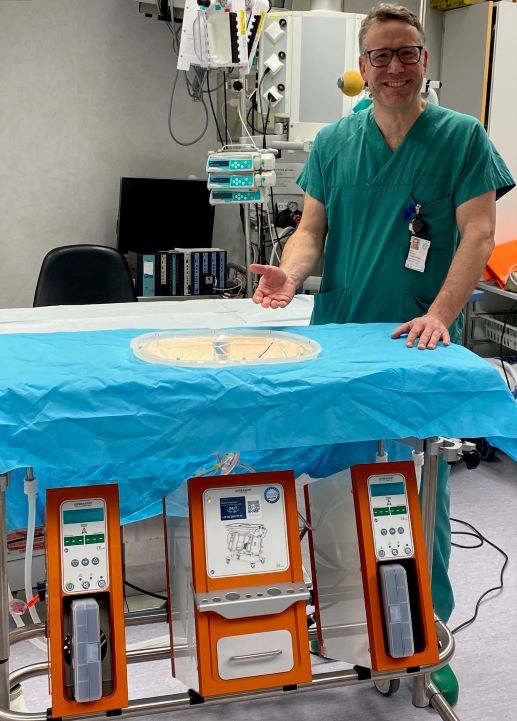
36 per cent of all donated livers are currently discarded due to uncertainty about their quality and whether they will function as they should in the recipient. The so-called perfusion machine makes sure that a donated liver maintains its viability outside the donor’s body for many hours and enables the quality of the liver to be checked before transplantation.
It is highly probable that in the course of 2025, a donated liver can be used to save the lives of more people who need a new liver. Research being carried out on small crucian carp fish may be able to save even more lives in the long term.
Interesting differences between crucian carp and mice
- The scientific journal Acta Physiologia has recently published the 3DR Group’s most recent study, where we have compared cardiac mitochondria from the anoxia-tolerant carp with anoxia-intolerant mice. Anoxia means a total absence of oxygen. Even though the mitochondria (the power-generating components of cells) behaved remarkably similarly, there were some distinct and interesting differences, says Kåre-Olav Stensløkken, professor at the Institute of Basic Medical Studies.
The antioxidant defences in the fish were stronger and produced far less harmful reactive oxygen compounds. Both these things pose challenges when it comes to transplantations, which the 3DR Group are working on. They are now carrying out intensive research on the processes occurring in the fish and Stensløkken believes that part of the key lies in the mitochondria.
Crucian carp avoids oxygen damage
- I am currently in Cambridge with rat liver samples which have been on a machine we have built resembling the one which will be built at the Norwegian National Hospital. In Cambridge, they are experts on mitochondria and heart attacks. Crucian carp have solved the problem of how to avoid harm when there is a lack of oxygen and when the oxygen returns. This species of fish can survive without oxygen for nearly three months under ice and also escape harm when oxygen returns to the water in the spring, explains Stensløkken, who has been doing research on crucian carp since he was a research fellow.
He and his team are responsible for the basic research, while anaesthesiologist and professor Søren Pischke and his group at the Department of Immunology and Transfusion Medicine, Anaesthesiology and Intensive Medicine are responsible for the clinical research, together with transplant surgeons at the National Hospital. Stensløkken and Pischke have both been members of the interdisciplinary 3DR Research Group at the Life Science Centre since 2018. Both the Faculty of Mathematics and Natural Sciences and the Faculty of Theology are also involved in the project.
Fewer organs will have to be discarded
Professor Pischke is glad that the new liver perfusion machine will soon be in use.
- It will ensure that fewer organs go to waste. At present, many donated livers have to be thrown away because they cannot be tested before a transplant takes place. Once we can test the livers outside the body of the recipient, we hope to be able to increase the number of viable livers by 20-30 per cent.
The machine undergoing tests is already in use in the Netherlands and a similar one is being used in England, and they are collaborating with the Netherlands on their study.
- We hope to be able to transplant tested livers in 2025. We are well underway and training is currently in progress. It is important that we don’t expose vulnerable patients to danger and we must therefore take our time, but we must soon get started, says an impatient Pischke.
Whereas the livers are currently only being tested for functionality, an even larger number of livers, and thereby also patients, will probably be able to be saved, thanks to research on crucian carp.
- Most of our collaboration concentrates on testing the function of mitochondria. I hope Stensløkken and his team find mechanisms that can make livers more resilient and ideally lead to an improvement in mitochondrial function, comments Pischke, adding that the 3DR Group’s work is an important example of good, interdisciplinary research collaboration.
Read the study in its entirety
Lucie Gerber and May-Kristin Torp are the first authors of the study published in Acta Physiologica, and Sjannie Lefevre and Kåre-Olav Stensløkken are the senior authors.