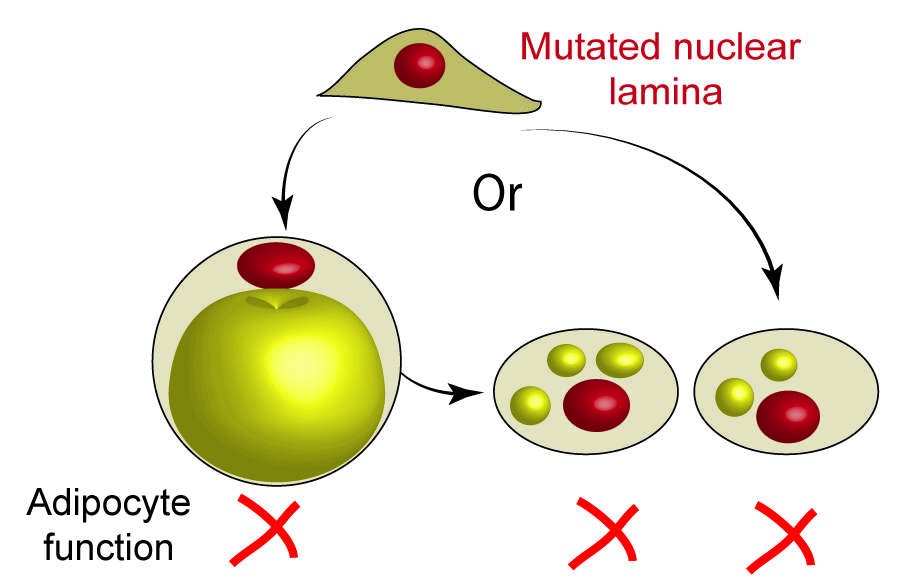
Mutations in the lamin A (LMNA) gene, encoding nuclear lamin A/C, cause laminopathies, including familial partial lipodystrophies of Dunnigan type (FPLD2). Partial lipodystrophies affect adipose tissue in a depot-specific manner and leads to severe metabolic complications. Using patient-derived cells and engineered adipose stem cells expressing LMNA mutants, we investigate how FPLD2-causing LMNA mutations deregulate genome and chromatin architecture and function. Other mutations in the LMNA gene cause muscle dystrophies. We also explore how such mutations affect chromatin organization in models of myogenic differentiation. We combine cell biology, microscopy, proteomics and genomics approaches.
Ongoing research
Impact of FPLD2-causing lamin A mutations on functional chromatin organization during adipogenesis
Impact of lamin A mutations on nuclear envelope integrity
De-regulation of chromatin at the nuclear periphery by lamin A mutations causing lipodystrophies and muscle dystrophies
FLPD2-causing lamin A p.R482W mutation deregulates vascular differentiation gene networks in an iPS cell model of FPLD2 (Briand, Guénantin 2018 Hum Moll Genet)
Lamin A p.R482W alters radial positioning of loci in FPLD2 patient fibroblasts (Paulsen 2017 Genome Biol)
Lamin A mutation deregulates epigenetic and spatial conformation of anti-adipogenic MIR335 locus (Oldenburg 2017 J Cell Biol)