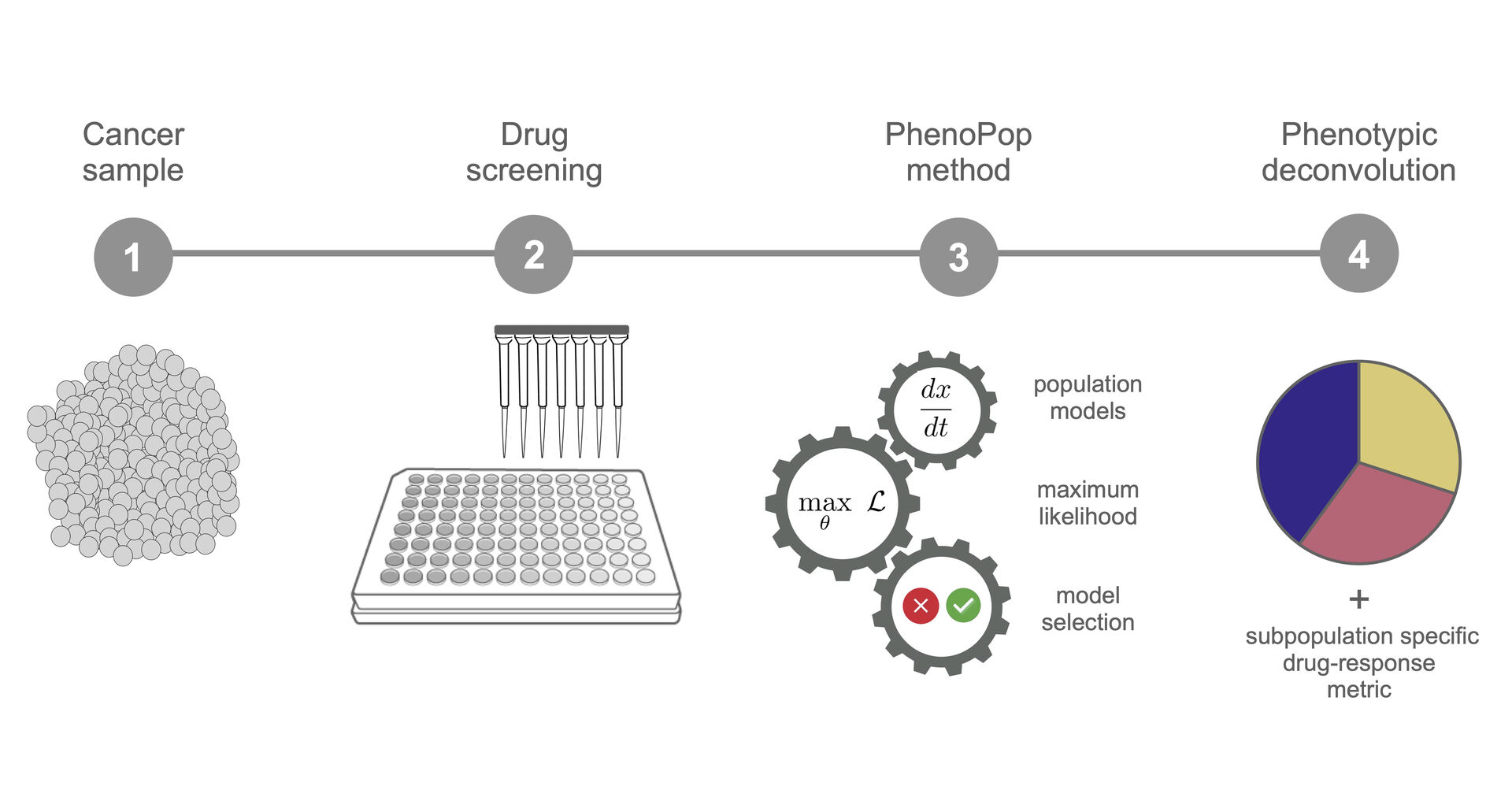
Vi utviklet en ny metode kalt PhenoPop som identifiserer tumor-subpopulasjoner med ulik respons på medisinering. Se vår preprint for detaljer.
Bakgrunn
MSc (2020) i Industriell Matematikk ved Norges teknisk-naturvitenskapelige universitet (NTNU). Masteravhandling om en modell for latent variabel-inferens innen nevrovitenskap veiledet av Benjamin Dunn.
Tumor heterogeneity is a complex and widely recognized trait that poses significant challenges in developing effective cancer therapies. In particular, many tumors harbor a variety of subpopulations with distinct therapeutic response characteristics. Characterizing this heterogeneity by determining the subpopulation structure within a tumor enables more precise and successful treatment strategies. In our prior work, we developed PhenoPop, a computational framework for unravelling the drug-response subpopulation structure within a tumor from bulk high-throughput drug screening data. However, the deterministic nature of the underlying models driving PhenoPop restricts the model fit and the information it can extract from the data. As an advancement, we propose a stochastic model based on the linear birth-death process to address this limitation. Our model can formulate a dynamic variance along the horizon of the experiment so that the model uses more information from the data to provide a more robust estimation. In addition, the newly proposed model can be readily adapted to situations where the experimental data exhibits a positive time correlation. We test our model on simulated data (in silico) and experimental data (in vitro), which supports our argument about its advantages.
Skjerven, Helle; Myklebust, Even Moa; Korvald, Christian; Stubberud, Kjetil; Hovda, Tone & Porojnicu, Alina Carmen
[Vis alle 10 forfattere av denne artikkelen](2023).
Long-term follow-up of complex oncoplastic breast-conserving surgery, standard breast conservation and skin-sparing mastectomy in DCIS - a register-based study.
European Journal of Surgical Oncology.
ISSN 0748-7983.
50(2).
doi: 10.1016/j.ejso.2023.107938.
Fulltekst i vitenarkiv
Tumor heterogeneity is an important driver of treatment failure in cancer since therapies often select for drug-tolerant or drug-resistant cellular subpopulations that drive tumor growth and recurrence. Profiling the drug-response heterogeneity of tumor samples using traditional genomic deconvolution methods has yielded limited results, due in part to the imperfect mapping between genomic variation and functional characteristics. Here, we leverage mechanistic population modeling to develop a statistical framework for profiling phenotypic heterogeneity from standard drug-screen data on bulk tumor samples. This method, called PhenoPop, reliably identifies tumor subpopulations exhibiting differential drug responses and estimates their drug sensitivities and frequencies within the bulk population. We apply PhenoPop to synthetically generated cell populations, mixed cell-line experiments, and multiple myeloma patient samples and demonstrate how it can provide individualized predictions of tumor growth under candidate therapies. This methodology can also be applied to deconvolution problems in a variety of biological settings beyond cancer drug response.
Skjerven, Helle; Myklebust, Even Moa; Korvald, Christian; Porojnicu, Alina Carmen; Kåresen, Rolf & Hofvind, Solveig Sand-Hanssen
[Vis alle 8 forfattere av denne artikkelen](2022).
Oncological outcomes after simple and skin-sparing mastectomy of ductal carcinoma in situ: A register-based cohort study of 576 Norwegian women.
European Journal of Surgical Oncology.
ISSN 0748-7983.
doi: 10.1016/j.ejso.2022.11.594.
Fulltekst i vitenarkiv
Myklebust, Even Moa
(2023).
Relapse prediction in Multiple Myeloma patients through Mathematical modeling.
Fulltekst i vitenarkiv
Myklebust, Even Moa
(2023).
Personalized treatment recommendations for Multiple Myeloma with a Hierarchical Bayesian model.
Fulltekst i vitenarkiv
Myklebust, Even Moa
(2023).
Predicting treatment response in Multiple Myeloma by combining mechanistic modeling with statistical learning in a Hierarchical Bayesian framework.
Fulltekst i vitenarkiv
Myklebust, Even Moa
(2023).
A framework for personalized prognosis of tumor evolution in Multiple Myeloma.
Fulltekst i vitenarkiv
Myklebust, Even Moa
(2023).
Predicting treatment response in Multiple Myeloma by combining mechanistic modeling with statistical learning in a Hierarchical Bayesian framework.
Fulltekst i vitenarkiv
Myklebust, Even Moa
(2023).
Predicting Progression Free Survival in Multiple Myeloma with a Hierarchical Bayesian model.
Fulltekst i vitenarkiv
Myklebust, Even Moa
(2023).
Skin-sparing vs simple mastectomy for DCIS.
Fulltekst i vitenarkiv
Myklebust, Even Moa
(2023).
Relapse prediction in Multiple Myeloma patients through Mathematical modeling.
Fulltekst i vitenarkiv
Myklebust, Even Moa
(2022).
A framework for personalized prognosis of tumor evolution in Multiple Myeloma by multi-output statistical learning.
Fulltekst i vitenarkiv
Myklebust, Even Moa
(2022).
Phenotypic deconvolution in heterogeneous cancer cell populations using drug screening data.
Fulltekst i vitenarkiv
Myklebust, Even Moa
(2022).
Phenotypic deconvolution in heterogeneous cancer cell populations using drug screening data.
Fulltekst i vitenarkiv
Myklebust, Even Moa
(2022).
Phenotypic deconvolution in heterogeneous cancer cell populations using drug screening data.
Fulltekst i vitenarkiv
Myklebust, Even Moa
(2022).
Phenotypic deconvolution in heterogeneous cancer cell populations using drug screening data.
Fulltekst i vitenarkiv
Myklebust, Even Moa
(2021).
Phenotypic deconvolution of cancer drug screens.
Fulltekst i vitenarkiv
90.jpg)
90.jpg?alt=original&vrtx=view-as-webpage
)