I tillegg til å undervise på medisinstudiet og på ulike emner ved UiO, underviser jeg for helsepersonell på seminarer og kurs i regi av Senter for medisinsk etikk, og på forespørsel fra andre universiteteter og høgskoler, samt for ansatte i helsetjenesten rundt om i landet. På UiO underviser jeg på følgende emner:
2025 - Å ha ansvar for barn med spiseforstyrrelse – en studie av foreldre/foresattes erfaringer med helsetjeneste og behandling
2024 - Prosjektleder: Kartlegging av etikkarbeid i helse- og omsorgstjenesten i norske kommuner
2021- Prosjektleder: Etikkrefleksjon i boliger for personer med utviklingshemming
2020-2025 Prosjektleder: Etikk i kommunale hjemmetjenester, finansiert av Stiftelsen Dam
2022 - 2023 Prosjektdeltaker: Kartlegging av tvungen helsehjelp ved sykehjem i Oslo, UiO og Aldring og helse.
2020-2023 Prosjektleder (kvalitativ del): GeroCovid Norway; An observational cohort study on change in health related quality of life (HRQoL) and functional capacity in older people with COVID-19
2016-2020: Prosjektleder: Etikkrefleksjon i skolehelsetjenesten, Senter for medisinsk etikk, UiO
2013-2019 Prosjektleder: Sykepleierstudenter og empati - en kvalitativ studie OsloMet og UiO
2010-2013: Prosjektdeltaker: "A life in dignity", skandinavisk forskningsprosjekt ledet av professor Dagfinn Nåden og finansiert av NFR
Heggestad, Anne Kari Tolo; Gjermestad, Anita & Sævareid, Trygve Johannes Lereim
(2025).
Betydningen av etikkrefleksjon for samarbeidet mellom ansatte og pårørende i botilbud til personer med utviklingshemming.
Nordisk välfärdsforskning | Nordic Welfare Research.
11(1),
s. 1–14.
doi: 10.18261/nwr.11.1.2.
Fulltekst i vitenarkivVis sammendrag
Voksne personer med utviklingshemming leier eller eier ofte egen bolig, men vil samtidig være avhengig av støtte fra både profesjonelle og pårørende. I samarbeidet mellom pårørende og profesjonelle kan det oppstå etiske utfordringer. For å bedre samarbeidet med pårørende ble det i en større norsk kommune startet opp refleksjonsgrupper der ansatte og pårørende til personer med utviklingshemming deltok. I etterkant av dette prosjektet ble det gjennomført et forskningsprosjekt der hensikten var å avdekke etiske utfordringer ansatte og pårørende opplever i samarbeidet om omsorgen for personer med utviklingshemming. Videre har hensikten vært å synliggjøre hvilken betydning etikkrefleksjon kan ha for samarbeidet. Det ble gjennomført fokusgruppeintervjuer med ansatte og dybdeintervjuer med pårørende. Intervjuene ble så analysert tematisk. Studien viste at utfordringene som oppsto, handlet om en spenning mellom familiære verdier og institusjonelle verdier. Gjennom etikkrefleksjon opplevde både ansatte og pårørende at de fikk en større forståelse av hverandres perspektiver, som igjen bidro til å minske spenningen. Funnene blir diskutert i lys av ulike omsorgslogikker og en diskursetisk tilnærming.
Hertzberg, Cecilie Knagenhjelm; Magelssen, Morten & Heggestad, Anne Kari Tolo
(2025).
Seeing several sides of the story: Unpacking an ethical dilemma in home-based care.
Journal of Aging Studies.
ISSN 0890-4065.
73.
doi: 10.1016/j.jaging.2025.101323.
Fulltekst i vitenarkivVis sammendrag
Healthcare professionals in home-based care face various challenges at the system and patient levels, which can lead to ethical dilemmas. In addition, home-based care workers lack arenas to share their experiences, as they are often scattered across the care district, work alone, and do not have the immediate support of a colleague. Based on ethnographic fieldwork among professional caregivers in home-based care in Norway, we present a case of an ethical dilemma that occurred during a patient visit. Using a narrative ethics approach, we unpack the case into six “stories” and show the context of the ethical dilemma. Home-based care staff may not be aware of an ethical dilemma as it unfolds. Reflection on the case leads us to suggest that staff would benefit from some form of clinical ethics support to learn, share stories, and receive support. We also suggest that professional caregivers and patients would benefit from advance care planning as a way to clarify expectations between patients and healthcare professionals. Clinical ethics support and advance care planning are ways for staff and patients, respectively, to let their voices and stories be heard.
Lausund, Hilde; Jøranson, Nina; Breievne, Grete; Myrstad, Marius; Heiberg, Kristi Elisabeth & Walle-Hansen, Marte
[Vis alle 7 forfattere av denne artikkelen](2024).
Older people's experiences of vulnerability in a trust-based welfare society affected by the COVID-19 pandemic.
Nursing Inquiry (NI).
ISSN 1320-7881.
31(3),
s. 1–10.
doi: 10.1111/nin.12643.
Fulltekst i vitenarkivVis sammendrag
The early coronavirus disease 2019 (COVID-19) outbreak inflicted vulnerability on individuals and societies on a completely different scale than we have seen previously. The pandemic developed rapidly from 1 day to the next, and both society and individuals were put to the test. Older people's experiences of the early outbreak were no exception. Using an abductive analytical approach, the study explores the individual experiences of vulnerability as described by older people hospitalised with COVID–19 in the early outbreak. In these older people, we found that the societal context and the individual experiences of vulnerability were inextricable linked. The study demonstrates that despite significant individual stress, informants displayed an interesting ability to also view their situation to reorient their perspective. The experience of vulnerability is both conditional and individual, which imposes a degree of unpredictability that neither they nor others were able to negotiate. The article discusses the phenomenon of unpredictability in light of a modern society with regard to how individuals and society may encounter unexpected events in the future where the potential to reorient will be vital.
Hertzberg, Cecilie Knagenhjelm; Magelssen, Morten & Heggestad, Anne Kari Tolo
(2024).
Putting patients first: when home-based care staff prioritise loyalty to patients above the system and themselves. An ethnographic study.
BMC Medical Ethics.
25(1).
doi: 10.1186/s12910-024-01094-0.
Fulltekst i vitenarkivVis sammendrag
Background
The growing number of older people worldwide poses challenges for health policy, particularly in the Global North, where policymakers increasingly expect seniors to live and receive care at home. However, healthcare professionals, particularly in home-based care, face dilemmas between adhering to care ideals and meeting external demands. Although they strive to uphold ethical care standards, they must deal with patients’ needs, cooperation with colleagues and management guidelines. Home-based care is an essential part of healthcare services in Norway, but staff struggle with high patient numbers and time management. This article focuses on how staff deal with ethical challenges related to contextual and organisational constraints.
Methods
An ethnographic fieldwork in three municipalities in South-East Norway. The first author conducted three to four months of participant observation in each municipality. In addition, she conducted in-depth interviews with key informants in two municipalities and a focus group interview with seven home-based care workers in one municipality. The data was analysed by using a reflexive thematic analysis.
Results
Staff in home-based care are frequently more loyal to the patient than to the system and to their own needs. To provide good care, all informants disregarded the patient’s formal decision, i.e. they provided more care than the formalised decision stipulated. To prioritise beneficence to patients, informants also disregarded some of the rules applicable in home-based care. In addition, staff accepted risks to their own safety and health to provide care in the patient’s home.
Conclusion
The loyalty of home-based care staff to their patients can go beyond their loyalty to the rules of the system and even their own safety. This commitment might be attributed to a sense of doing meaningful work, to providing relationship-based and individualised care, and to strong moral courage. However, the staff’s emphasis on flexibility and individualised care also brings challenges related to unclear boundaries related to patient care.
Jøranson, Nina; Synnes, Oddgeir; Heggestad, Anne Kari Tolo; Breievne, Grete; Myrstad, Marius & Heiberg, Kristi Elisabeth
[Vis alle 8 forfattere av denne artikkelen](2023).
‘A Story of Being Invisible’: A Single Case Study on the Significance of Being Recognised When Needing Acute Healthcare in the Early COVID-19 Pandemic.
Qualitative Health Research.
ISSN 1049-7323.
33(12).
doi: 10.1177/10497323231197375.
Fulltekst i vitenarkivVis sammendrag
Severe illness is often an existential threat that triggers emotions like fear, stress, and anxiousness. Such emotions can affect ill patients’ encounters with healthcare personnel. We present a single case study of an older woman who contracted COVID-19 and her challenge to be recognised by healthcare personnel in the early pandemic. Storytelling is vital to understand how patients can create meaning in illness as it gives them the opportunity to reshape and restore their past and to project a future. We used Arthur Frank’s dialogical narrative analysis to explore how one patient experienced her encounters with healthcare personnel. Although she felt very ill from COVID-19, she experienced being almost invisible and not being believed by healthcare personnel in a system marked by high stress levels and uncertainty. Despite rejections and illness, she managed to mobilise her resources, even though she depended on significant others. Her story brings forward altered self-understanding and growth. The importance of facilitating dialogical settings for healthcare professionals through patient storytelling also contributes to a broader societal understanding of illness beyond a biological perspective.
Hertzberg, Cecilie Knagenhjelm; Heggestad, Anne Kari Tolo & Magelssen, Morten
(2023).
Blurred lines: Ethical challenges related to autonomy in home-based care.
Nursing Ethics.
ISSN 0969-7330.
doi: 10.1177/09697330231215951.
Fulltekst i vitenarkivVis sammendrag
Background Home-based care workers mainly work alone in the patient’s home. They encounter a diverse patient population with complex health issues. This inevitably leads to several ethical challenges. Aim The aim is to gain insight into ethical challenges related to patient autonomy in home-based care and how home-based care staff handle such challenges. Research design The study is based on a 9-month fieldwork, including participant observation and interviews in home-based care. Data were analysed with a thematic analysis approach. Participants and research context The study took place within home-based care in three municipalities in Eastern Norway, with six staff members as key informants. Ethical considerations The Norwegian Agency for Shared Services in Education and Research evaluated the study. All participants were competent to consent and signed an informed consent form. Findings A main challenge was that staff found it difficult to respect the patient’s autonomy while at the same time practicing appropriate care. We found two main themes: Autonomy and risk in tension; and strategies to balance autonomy and risk. These were explicated in four sub-themes: Refusing and resisting care; when choosing to live at home becomes risky; sweet-talking and coaxing; and building trust over time. Staff’s threshold for considering the use of coercion appeared to be high. Conclusions Arguably, home-based care staff need improved knowledge of coercion and the legislation regulating it. There is also a need for arenas for ethics reflection and building of competence in balancing ethical values in recurrent ethical problems.
Introduction: Expressions of dignity as a clinical phenomenon in nursing homes as expressed by caregivers were investigated. A coherence could be detected between the concepts and phenomena of existence and dignity in relationships and caring culture as a context. A caring culture is interpreted by caregivers as the meaning-making of what is accepted or not in the ward culture. Background: The rationale for the connection between existence and dignity in relationships and caring culture is that suffering is a part of existence, as well as compassion in relieving suffering, and ontological interdependency. Aim: To describe different expressions of dignity in relationships and existence in context of caring cultures from the perspective of the caregivers. Research design: The methodology and method are hermeneutic. The method used was to merge the theoretical preunderstanding as one horizon of understanding with empirical data. Participants and research context: Focus group interviews with caregivers in nursing homes. Ethical considerations: The principles of the Helsinki Declaration have been followed to, for example, preserve self-determination, integrity, dignity, confidentiality and privacy of the research persons. Findings: Data interpretation resulted in four themes: Encountering existential needs that promote dignity in a caring culture; To amplify dignity in relationships by the creative art of caring in a caring culture; Violation of dignity by ignorance or neglect in a non-caring culture and The ethic of words and appropriated ground values in a caring culture. Discussion: Dignity-promoting acts of caring, or dignity-depriving acts of non-caring are adequate to see from the perspective of dignity in relationships and existence and the caring culture. Conclusions: Dignity in relationships seems to touch the innermost existential life, as the existential life is dependent on confirmation from others.
Heiberg, Kristi Elisabeth; Heggestad, Anne Kari Tolo; Jøranson, Nina; Lausund, Hilde; Breievne, Grete & Myrstad, Marius
[Vis alle 9 forfattere av denne artikkelen](2022).
‘Brain fog’, guilt, and gratitude: experiences of symptoms and life changes in older survivors 6 months after hospitalisation for COVID-19.
European Geriatric Medicine.
ISSN 1878-7649.
13(13),
s. 695–703.
doi: 10.1007/s41999-022-00630-8.
Fulltekst i vitenarkivVis sammendrag
Aim The aim of the study is to explore older participants’ experiences of symptoms and life changes approximately 6 months
after hospitalisation for COVID-19.
Findings The participants experienced various persistent physical and cognitive symptoms. At the same time, they experi-
enced gratitude for having survived and for having achieved new life perspectives.
Message Despite suffering from the post-COVID-19 condition the older adults’ coping resources helped them achieve new
life perspectives
Heggestad, Anne Kari Tolo; Konow-Lund, Anne-Sophie; Christiansen, Bjørg & Nortvedt, Per
(2022).
A vulnerable journey towards professional empathy and moral courage.
Nursing Ethics.
ISSN 0969-7330.
29(4).
doi: 10.1177/09697330221074013.
Fulltekst i vitenarkivVis sammendrag
Background: Empathy and moral courage are important virtues in nursing and nursing ethics. Hence, it is of great importance that nursing students and nurses develop their ability to empathize and their willingness to demonstrate moral courage. Research aim: The aim of this article is to explore third-year undergraduate nursing students’ perceptions and experiences in developing empathy and moral courage. Research design: This study employed a longitudinal qualitative design based on individual interviews. Participants and research context: Seven undergraduate nursing students were interviewed during or immediately following their final clinical placement. Ethical considerations: The Norwegian Social Science Data Services (NSD) approved the study. Participants were informed that their participation was voluntary and were assured confidentiality. They were informed that they could withdraw from the study at any time, without providing reasons. Findings: Affective empathy seemed to be strong among third-year undergraduate nursing students. However, they tried to handle the situations in a ‘professional’ way, and to balance their emotions. At the same time, they expressed how difficult it can be to show moral courage when confronted with poor patient care. In addition, they spoke about a lack of role models during clinical practice and supervision. Conclusions: Undergraduate nursing students are in a vulnerable position throughout their journey to become professional and to develop empathy and moral courage. The professional socialisation and forming of professional empathy and moral courage among nursing students, may be seen as a complex interaction of formal and hidden curriculum, where role models play an important role. We argue that the main theme ‘Vulnerable students – a journey towards professional empathy and moral courage’ may cover the longitudinal project as a whole. This vulnerability is something both teachers and supervisors should be aware of when following up with students in their clinical placements.
In March 2020, the COVID-19 pandemic challenged both the Norwegian population and healthcare system. In this study we explored how older men and women experienced rehabilitation and recovery after hospitalisation due to severe COVID-19.
Methods:
Semi-structured interviews with 17 participants aged 60–96 years were performed 6 months after discharge from hospital. A thematic descriptive analysis was conducted.
Results
The results revealed that the participants experienced a challenging span between loneliness and companionship in recovering from severe COVID-19. The four subthemes highlighted experiences of being discharged to home and left to themselves, the importance of exercise and companionship at rehabilitation stay, requirement of self-effort and time to recover, and the challenging span between loneliness and companionship when being with family.
Conclusion:
Among participants, the experiences of loneliness throughout the recovery period were striking. An individualised approach including psychological support should be emphasized in primary healthcare to promote recovery in older survivors after severe COVID-19 and their next-of-kin.
Storaker, Anne; Heggestad, Anne Kari Tolo & Sæteren, Berit
(2022).
Ethical challenges and lack of ethical language in nurse leadership.
Nursing Ethics.
ISSN 0969-7330.
29(6),
s. 1372–1385.
doi: 10.1177/09697330211022415.
Fulltekst i vitenarkiv
Background: Equal access to healthcare is a core principle in Norway’s public healthcare system. The
COVID-19 pandemic challenged healthcare systems in the early phase – in particular, related to testing and
hospital capacity. There is little knowledge on how older people experienced being infected with an unfamiliar
and severe disease, and how they experienced the need for healthcare early in the pandemic Aim: To explore the experiences of older people infected by COVID-19 and their need for testing and
hospitalisation.
Research design: An explorative and descriptive approach, with qualitative interviews conducted in
October 2020.
Participants and research context: Seventeen participants above 60 years of age hospitalised due to
COVID-19 during spring 2020 were recruited 6 months after discharge.
Ethical considerations: Ethical approval was granted by the Regional Committee for Medical and Health
Research Ethics in South-Eastern Norway (155425).
Findings: The main finding was that the informants experienced vulnerability and arbitrariness. This finding
was supported by three sub-themes: experiences with a severe and unfamiliar disease, the strict criteria and
the importance of someone advocating needs.
Discussion: Participants described varying access to healthcare. Those who did not meet the national
criteria to be tested or hospitalised struggled against the system. Findings reveal arbitrary access to
healthcare, in contrast to Norway’s ethical principle of fair and just access to health services. Moreover, to
access and receive necessary healthcare, informants were dependent on their next-of-kin’s advocacy.
Conclusion: Even when dealing with an unfamiliar disease, health professionals’ assessments of symptoms
must be performed with an ethical obligation to applicate competent appraisal and the exercise of dis-
cernment; this is in line with care ethics and ethical standards for nurses. These perspectives are a significant
part of caring and the intension of doing good.
Konow-Lund, Anne-Sophie; Christiansen, Bjørg; Heggestad, Anne Kari Tolo & Nortvedt, Per
(2021).
Sykepleierstudentens empati i møte med sårbare pasienter.
Klinisk Sygepleje.
ISSN 0902-2767.
35(3),
s. 181–193.
doi: 10.18261/ISSN.1903-2285-2021-03-02.
Fulltekst i vitenarkiv
Bakgrunn: Med et økende antall eldre følger et økende press på kommunale helse- og omsorgstjenester. Det betyr blant annet at det kan bli vanskeligere å få sykehjemsplass. For å sikre rettferdig tildeling er det av stor betydning å få kunnskap om hva som påvirker prioriteringene. Da må vi også vite hvilken rolle pårørende spiller i tildelingsprosessen. Hensikt: Hensikten med artikkelen var å undersøke pårørendes rolle i tildelingen av langtidsplass på sykehjem. Metode: Studien bygger på kvalitativ metode med en eksplorativ tilnærming. Vi inkluderte fire kommuner og gjennomførte 16 intervjuer med saksbehandlere på tildelingskontor samt sykepleiere og leger på korttidsavdelinger. Vi foretok også 13 observasjoner av møter mellom saksbehandlere og helsepersonell ved korttidsavdelingene. Vi gjorde en tematisk innholdsanalyse av intervjuer og feltnotater. Resultat: Deltakerne i studien opplevde at pårørende spiller en viktig rolle i tildelingsprosessen av kommunale helse- og omsorgstjenester. De kan bidra som en viktig omsorgsressurs og dermed også være en «buffer» i systemet. Samtidig er de ofte pådrivere i tildelingen av langtidsplass på sykehjem. Det kan true våre idealer om rettferdighet og likebehandling. Konklusjon: Det er viktig med åpne tildelingsprosesser og ekstra søkelys på pasienter uten sterke pårørende. Pårørende som stiller opp som buffere i helsetjenesten, trenger oppmerksomhet og avlastning. Det er behov for tydeligere retningslinjer for hva som skal være pårørendes ansvar, og hva som er det offentliges ansvar.
Heggestad, Anne Kari Tolo
(2020).
Å bli tatt på alvor som menneske med demens,
Verdighet og sårbarhet - en vitenskapelig antologi.
Gyldendal Akademisk.
ISSN 9788205513921.s. 28–40.Fulltekst i vitenarkiv
Heggestad, Anne Kari Tolo; Magelssen, Morten; Pedersen, Reidar & Gjerberg, Elisabeth
(2020).
Ethical challenges in home-based care: A systematic literature review.
Nursing Ethics.
ISSN 0969-7330.
doi: 10.1177/0969733020968859.
Fulltekst i vitenarkiv
Heggestad, Anne Kari Tolo; Førde, Reidun; Magelssen, Morten & Arnekleiv, Birgit
(2020).
Ethics reflection groups for school nurses.
Nursing Ethics.
ISSN 0969-7330.s. 1–11.
doi: 10.1177/0969733020940373.
Fulltekst i vitenarkiv
The Covid-19 pandemic creates an unprecedented threatening situation worldwide with an urgent need for critical reflection and new knowledge production, but also a need for imminent action despite prevailing knowledge gaps and multilevel uncertainty. With regard to the role of research ethics in these pandemic times some argue in favor of exceptionalism, others, including the authors of this paper, emphasize the urgent need to remain committed to core ethical principles and fundamental human rights obligations all reflected in research regulations and guidelines carefully crafted over time. In this paper we disentangle some of the arguments put forward in the ongoing debate about Covid-19 human challenge studies (CHIs) and the concomitant role of health-related research ethics in pandemic times. We suggest it might be helpful to think through a lens differentiating between risk, strict uncertainty and ignorance. We provide some examples of lessons learned by harm done in the name of research in the past and discuss the relevance of this legacy in the current situation.
Heggestad, Anne Kari Tolo
(2019).
Livshistoriefortelling og opplevelse av verdighet og anerkjennelse for personer med demens i sykehjem.
I Svalastog, Anna Lydia; Kristoffersen, Nina M. J. & Lile, Hadi Strømmen (Red.),
Psykososialt arbeid: Kunnskap, verdier og samfunn.
Gyldendal Akademisk.
ISSN 9788205512443.s. 251–263.Fulltekst i vitenarkiv
Heggestad, Anne Kari Tolo & Førde, Reidun
(2019).
Is allocation of nursing home placement in Norway just?
Scandinavian Journal of Caring Sciences.
ISSN 0283-9318.
doi: 10.1111/scs.12792.
Fulltekst i vitenarkivVis sammendrag
Background One of the core ethical principles in the Norwegian welfare state is the principle of justice; all citizens should have equal access to healthcare services, including nursing homes, independent of where they live, socioeconomic status or age. Patients who apply for a permanent place in a nursing home are among society’s most vulnerable. Hence, it is of great importance that the process of nursing home placement is just. The purpose of this study was to explore which criteria and values allocation of nursing home placements are built on, and whether the process is just. Methods The study has a qualitative design. Data were collected through individual interviews and observation. Executive officers in different municipalities who have the formal responsibility for the placements, and GPs and nurses on short‐term wards in nursing homes were interviewed. In addition, one of the researchers observed meetings where allocation of municipal healthcare services was discussed. Results Healthcare personnel in primary health care mainly agree on which criteria are the most important in order to safeguard the principle of justice. However, some unintended and less highlighted factors could jeopardise the ideal of fair and just allocation. Some of these were organizational variations, variations in the municipalities’ economy, variations in individual judgments and resourceful and strong‐willed relatives. Conclusions Our study indicates that some of the weakest and most vulnerable patients in the Norwegian society are not treated equally. In order to safeguard the principle of justice, specific national criteria should be used in allocation of nursing home placements. However, national criteria are not enough. We suggest that in addition to guiding criteria, the unintended factors should be given more attention and focus on how to control them in a better way.
Lindwall, Lillemor; Råholm, Maj-Britt; Lohne, Vibeke; Caspari, Synnøve; Heggestad, Anne Kari Tolo & Sæteren, Berit
[Vis alle 9 forfattere av denne artikkelen](2018).
Clinical Application Research through reflection, interpretation and new understanding - a hermeneutic design.
Scandinavian Journal of Caring Sciences.
ISSN 0283-9318.
32(3),
s. 1157–1167.
doi: 10.1111/scs.12561.
Fulltekst i vitenarkivVis sammendrag
The implementation of theoretical knowledge in clinical practice and the implementation of good clinical practice into theory have been of interest in caring science for the last 30 years. The aim of this article was to elaborate and discuss a methodology named clinical application research. The method is grounded in a hermeneutical design inspired by Gadamer's philosophy. The methodology, clinical application research, has been used in a research project A life in dignity and experiences from the researchers forms the bases for the elaboration and discussion. The project was performed in collaboration with residents, family caregivers and healthcare providers at six nursing homes in Scandinavia. The material for this article is based on the previous research, that is the results from 10 different articles showing the meaning of dignity and indignity in daily life in nursing homes. Data were generated from 56 individual interviews and 18 focus‐group interviews with a total of 40 staff members with five to eight participants at every interview session. By reflection, interpretation and new understanding our results provide knowledge about dignity and how to preserve dignity for older people in an appropriate ethical way. The methodology was relevant for the research project A life in dignity and relevant to caring practice in nursing homes as it opens new possibilities and new ways of thinking when performing dignified care to older people.
Caspari, Synnøve; Råholm, Maj-Britt; Sæteren, Berit; Rehnsfeldt, Arne Wilhelm; Lillestø, Britt & Lohne, Vibeke
[Vis alle 11 forfattere av denne artikkelen](2018).
Tension between freedom and dependence- A Challenge for residents who live in nursing homes.
Journal of Clinical Nursing (JCN).
ISSN 0962-1067.
27(21/22),
s. 4119–4127.
doi: 10.1111/jocn.14561.
Fulltekst i vitenarkiv
Konow-Lund, Anne-Sophie; Heggestad, Anne Kari Tolo; Nortvedt, Per & Christiansen, Bjørg
(2017).
Developing mature empathy among first-year students: The learning potential of emotional experiences.
The Nordic Journal of Nursing Research (NJNR).
ISSN 2057-1585.
38(3),
s. 128–134.
doi: 10.1177/2057158517722057.
Fulltekst i vitenarkivVis sammendrag
Nursing students’ ability to develop mature empathy requires emotional work, usually associated with caring experiences in relation with patients and next of kin. This article is based on qualitative in-depth interviews with 11 first-year students, and the research questions were: What characterizes situations in a nursing home that evoke strong emotional reactions in first-year students? What is the learning potential of these experiences? Findings show that facing emotionally challenging situations during their first clinical placement in nursing education aroused strong feelings and commitment among the students. The students tried, however, to find ways to handle emotionally challenging situations both with support in scientific literature, as well as from experience. Nurses were important role models, but could also exemplify characteristics of less empathic behaviour. Developing ‘mature empathy’ requires emotional work so that the students learn to adapt themselves to what will be demanded of them as professional nurses. The findings of this and other studies should alert nurses as well as teachers to the importance of helping students develop empathy as part of their learning trajectory in nursing education.
Heggestad, Anne Kari Tolo; Nortvedt, Per; Christiansen, Bjørg & Konow-Lund, Anne-Sophie
(2016).
Undergraduate nursing students`ability to empathize : A qualitative study.
Nursing Ethics.
ISSN 0969-7330.
25(6),
s. 786–795.
doi: 10.1177/0969733016664982.
Fulltekst i vitenarkiv
Background . Older people, living in nursing homes, are exposed to diverse situations, which may be associated with loss of dignity. To help them maintain their dignity, it is important to explore, how dignity is preserved in such context. Views of dignity and factors influencing dignity have been studied from both the residents ́ and the care providers ́ perspective. However, most of these studies pertain to experiences in the dying or the illness context. Knowledge is scarce about how older people experience their dignity within their everyday lives in nursing homes. Aim To illuminate the meaning of maintaining dignity from the perspective of older people living in nursing homes Method . This qualitative study is based on individual interviews. Twenty-eight nursing home residents were included from six nursing homes in Scandinavia. A phenomenological-hermeneutic approach, inspired by Ricoeur was used to understand the meaning of the narrated text. Results. The meaning of maintaining dignity was constituted in a sense of vulnerability to the self, and elucidated in three major interrelated themes: Being involved as a human being, being involved as the person one is and strives to become, and being involved as an integrated member of the society. Conclusion. The results reveal that maintaining dignity in nursing homes from the perspective of the residents can be explained as a kind of ongoing identity process based on opportunities to be involved, and confirmed in interaction with significant others.
Sæteren, Berit; Heggestad, Anne Kari Tolo; Høy, Bente; Lillestø, Britt; Slettebø, Åshild & Lohne, Vibeke
[Vis alle 12 forfattere av denne artikkelen](2016).
The dialectical movement between deprivation and preservation of a person's life space: A question of nursing home residents' dignity.
Holistic Nursing Practice.
ISSN 0887-9311.
30(3),
s. 139–147.
doi: 10.1097/HNP.0000000000000145.
Fulltekst i vitenarkiv
Slettebø, Åshild; Sæteren, Berit; Caspari, Synnøve; Lohne, Vibeke; Rehnsfeldt, Arne Wilhelm & Heggestad, Anne Kari Tolo
[Vis alle 12 forfattere av denne artikkelen](2016).
The significance of meaningful and enjoyable activities for nursing home resident’s experiences of dignity.
Scandinavian Journal of Caring Sciences.
ISSN 0283-9318.
31(4),
s. 718–726.
doi: 10.1111/scs.12386.
Fulltekst i vitenarkivVis sammendrag
Background Living in a nursing home may be challenging to the residents’ experience of dignity. Residents’ perception of how their dignity is respected in everyday care is important. Aim To examine how nursing home residents experience dignity through the provision of activities that foster meaning and joy in their daily life. Method A qualitative design was used and 28 individual semistructured interviews conducted with nursing home residents from six nursing homes in Denmark, Norway and Sweden. The data were analysed with qualitative content analysis. Independent ethical committees in all participating countries granted their approval for the study. Findings The participants highlight two dimensions of the activities that foster experiences of dignity in nursing homes in Scandinavia. These two categories were (i) fostering dignity through meaningful participation and (ii) fostering dignity through experiencing enjoyable individualised activities. Conclusion Activities are important for residents to experience dignity in their daily life in nursing homes. However, it is important to tailor the activities to the individual and to enable the residents to take part actively. Nurses should collect information about the resident's preferences for participation in activities at the nursing home.
Heggestad, Anne Kari Tolo; Høy, Bente; Sæteren, Berit; Slettebø, Åshild; Lillestø, Britt & Rehnsfeldt, Arne Wilhelm
[Vis alle 12 forfattere av denne artikkelen](2015).
Dignity, Dependence, and Relational Autonomy for Older People Living in Nursing Homes.
International journal for human caring.
ISSN 1091-5710.
19(3),
s. 42–46.
doi: 10.20467/1091-5710-19.3.42.
Fulltekst i vitenarkiv
Heggestad, Anne Kari Tolo; Nortvedt, Per & Slettebø, Åshild
(2015).
Dignity and care for people with dementia living in nursing homes.
Dementia.
ISSN 1471-3012.
14(6),
s. 825–841.
doi: 10.1177/1471301213512840.
Fulltekst i vitenarkivVis sammendrag
This article presents and discusses findings from a qualitative study on how the dignity of patients with dementia is preserved or harmed when they live in a nursing home. The results build on participant observation in two nursing home wards, combined with qualitative interviews with seven relatives of patients with dementia. The most important issue for relatives was that their family member with dementia was confirmed as a relational human being. However, relatives experienced lack of resources and task-centred care as threats to confirming, relational care and to patients’ dignity. Findings from participant observations confirmed this. In this article, we argue that care which focuses on the residents’ personhood, combined with a relational focus, is of great importance in maintaining the dignity of people with dementia living in nursing homes.
Heggestad, Anne Kari Tolo & Slettebø, Åshild
(2015).
How individuals with dementia in nursing homes maintain their dignity through life storytelling - A case study.
Journal of Clinical Nursing (JCN).
ISSN 0962-1067.
24(15-16),
s. 2323–2330.
doi: 10.1111/jocn.12837.
Fulltekst i vitenarkivVis sammendrag
Aims and Objectives The aim of this article is to present and discuss findings on what individuals with dementia do themselves to maintain or promote their dignity of identity when they live in a nursing home. Background The majority of residents living in Norwegian nursing homes suffer from dementia. Individuals who suffer from dementia are particularly vulnerable, and, their dignity of identity is at risk. It is therefore of great importance to explore how we can maintain their dignity of identity Design The study builds on a phenomenological and hermeneutic design. Methods The article reports three cases or life-stories based on participant observation in two different nursing homes and interviews with five residents with dementia living in these nursing homes. Fifteen residents with dementia from these nursing home wards were included in the overall study. Findings Individuals with dementia living in nursing homes may use life-story telling or narratives to manage chaos and to find safety in their lives. Storytelling is also used as a way to present and maintain identity. We can see this as a way of maintaining dignity of identity or social dignity. Conclusion Life-story telling can be seen as an important way of preserving dignity for people with dementia. It is of great importance that health care professionals are open to and listen to the life stories people with dementia tell. Relevance to clinical practice As nurses we have an obligation to ensure that dignity is enhanced in care for people with dementia. Knowledge about how residents with dementia use life-story telling as a way to maintain dignity is therefore of great importance to health care workers in nursing homes
Background: As part of an ongoing Scandinavian project on the dignity of care for older people, this study is based on ‘clinical caring science’ as a scientific discipline. Clinical caring science examines how ground concepts, axioms and theories are expressed in different clinical contexts. Central notions are caring culture, dignity, at-home-ness, the little extra, non-caring cultures versus caring cultures and ethical context – and climate.
Aim and assumptions: This study investigates the individual variations of caring cultures in relation to dignity and how it is expressed in caring acts and ethical contexts. Three assumptions are formulated: (1) the caring culture of nursing homes influences whether dignified care is provided, (2) an ethos that is reflected on and appropriated by the caregiver mirrors itself in ethical caring acts and as artful caring in an ethical context and (3) caring culture is assumed to be a more ontological or universal concept than, for example, an ethical context or ethical person-to-person acts.
Research design: The methodological approach is hermeneutic. The data consist of 28 interviews with relatives of older persons from Norway, Denmark and Sweden.
Ethical considerations: The principles of voluntariness, confidentiality and anonymity were respected during the whole research process.
Findings: Three patterns were revealed: dignity as at-home-ness, dignity as the little extra and non-dignifying ethical context.
Discussion: Caring communion, invitation, at-home-ness and ‘the little extra’ are expressions of ethical contexts and caring acts in a caring culture. A non-caring culture may not consider the dignity of its residents and may be represented by routinized care that values organizational efficiency and instrumentalism rather than an individual’s dignity and self-worth.
Conclusion: An ethos must be integrated in both the organization and in the individual caregiver in order to be expressed in caring acts and in an ethical context that supports these caring acts.
This qualitative study focused on dignity in nursing homes from the perspective of family caregivers. Dignity is a complex concept and central to nursing. Dignity in nursing homes is a challenge, according to research. Family caregivers are frequently involved in their family members’ daily experiences at the nursing home. Twenty-eight family caregivers were included in this Scandinavian cross-country, descriptive, and explorative study. A phenomenological-hermeneutic approach was used to understand the meaning of the narrated text. The interpretations revealed two main themes: “One should treat others as one would like others to treat oneself” and “Uneasiness due to indignity.” Dignity was maintained in experiences of respect, confidence, security, and charity. Uneasiness occurred when indignity arose. Although family caregivers may be taciturn, their voices are important in nursing homes. Further investigation of family caregivers’ experiences in the context of nursing homes is warranted.
Råholm, Maj-Britt; Lillestø, Britt; Lohne, Vibeke; Caspari, Synnøve; Sæteren, Berit & Heggestad, Anne Kari Tolo
[Vis alle 12 forfattere av denne artikkelen](2014).
Perspectives of Dignity of Residents Living in Nursing Homes– Experiences of Family Caregivers.
International journal for human caring.
ISSN 1091-5710.
18(4),
s. 34–39.
doi: 10.20467/1091-5710-18.4.34.
Fulltekst i vitenarkiv
Aims and objectives: The aim of this cross-country Scandinavian study was to explore how residents in nursing homes experience that their dignity is promoted and attended to. This is one part of the Scandinavian project in which we interviewed residents, relatives and staff members. Background: The main subject concerns the dignity of residents of nursing homes for older people. This article brings forward results from interviews of relatives on how they experience that the dignity is met, promoted and attended to for their next of kin. Design: The study was qualitative with a hermeneutic approach. Methods: Qualitative research interviews of 28 relatives of residents at six participating nursing homes in Scandinavia. The results derive from analysis of the interviews using Kvale’s three levels of interpretation; self-understanding, common sense and a theoretical understanding. Results: The following themes emerged, from the perspective of the relatives, concerning what was deemed important to the resident according his existential needs and concerns: a). To have a comfortable, homely and practical room. b). To have close contact with family, friends and with the staff. c). To have aesthetic needs and concerns attended to. d). To have ethical needs and intrinsic values attended to. e). To have cultural and spiritual needs and concerns attended to. Conclusion: The results provide more substance to the theme and are all important in terms of the residents’ feeling of worthiness and dignity. In general it seemed that the relatives experienced a positive encounter with the staff, but it was also mentioned that staff members were not confronted about episodes that were undignified and disgraceful. This could be a sign or expression that they were worried that negative responses or complaints could lead to a kind of reprisal against the resident and to indignity
Heggestad, Anne Kari Tolo; Nortvedt, Per & Slettebø, Åshild
(2013).
The importance of moral sensitivity when including persons with dementia in qualitative research.
Nursing Ethics.
ISSN 0969-7330.
20(1),
s. 30–40.
doi: 10.1177/0969733012455564.
Fulltekst i vitenarkivVis sammendrag
Abstract
The aim of this article is to show the importance of moral sensitivity when including persons with dementia
in research. The article presents and discusses ethical challenges encountered when a total of 15 persons
with dementia from two nursing homes and seven proxies were included in a qualitative study. The
examples show that the ethical challenges may be unpredictable. As researchers, you participate with
the informants in their daily life and in the interviews, and it is not possible to plan all that may happen
during the research. A procedural proposal to an ethical committee at the beginning of a research
project based on traditional research ethical principles may serve as a guideline, but it cannot solve all
the ethical problems one faces during the research process. Our main argument in this article is,
therefore, that moral sensitivity is required in addition to the traditional research ethical principles
throughout the whole process of observing and interviewing the respondents.
Heggestad, Anne Kari Tolo; Nortvedt, Per & Slettebø, Åshild
(2013).
'Like a prison without bars': Dementia and experiences of dignity.
Nursing Ethics.
ISSN 0969-7330.
20(8),
s. 881–892.
doi: 10.1177/0969733013484484.
Fulltekst i vitenarkivVis sammendrag
The aim of this article is to investigate how life in Norwegian nursing homes may affect experiences of dignity among persons with dementia. The study had a qualitative design and used a phenomenological and hermeneutic approach. Participant observation in two nursing homes units was combined with qualitative interviews with five residents living in these units. The study took place between March and December 2010. The residents feel that their freedom is restricted, and they describe feelings of homesickness. They also experience that they are not being seen and heard as individual autonomous persons. This lack of freedom, experiences of homesickness and feelings of not being confirmed and respected as individual autonomous persons, may be a threat to their personal dignity. In order to protect and enforce the dignity of persons with dementia living in nursing home, we should confirm them as whole and individual persons, and we should try to make the nursing homes less institutional and more home-like.
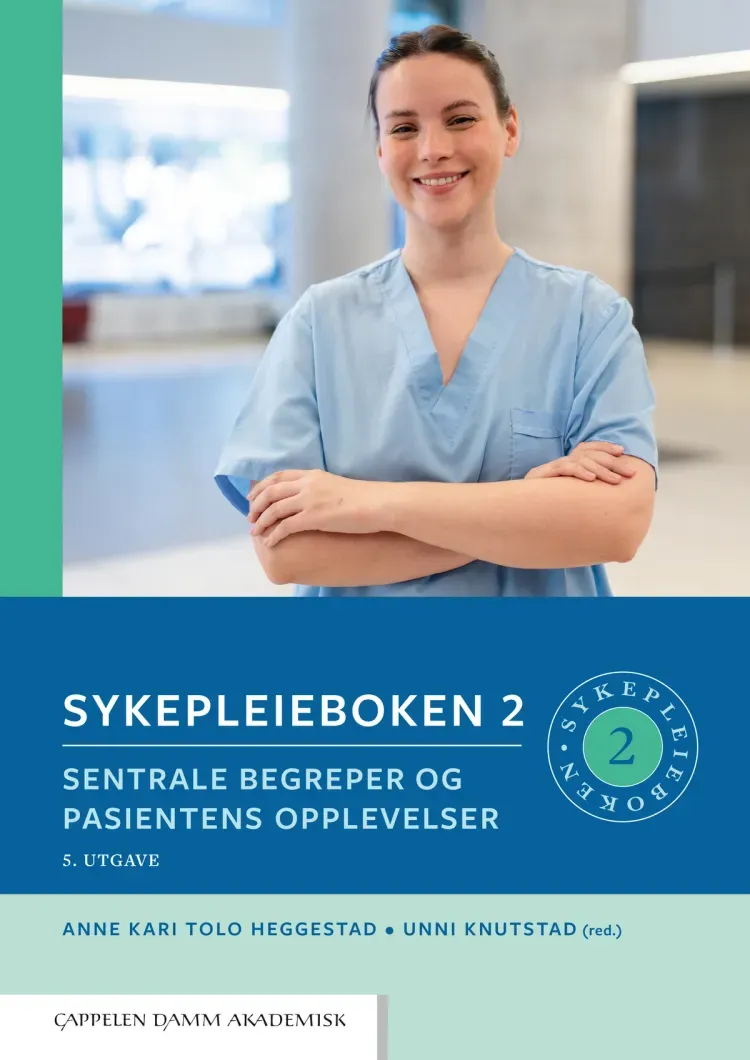
Sykepleieboken 2 – Sentrale begreper og pasientens opplevelser retter søkelyset mot en rekke fenomener som kan komme til syne ved sykdom og lidelse. Denne utgaven er betydelig redusert i omfang i forhold til forrige utgave. Alle kapitlene er oppdatert i forhold til nyere forskning og nye retningslinjer. Enkelte kapitler er nyskrevet med nye forfattere.
Boken tar for seg begrep og fenomener som verdighet, mestring, livskvalitet, håp og omsorg. Videre omhandler den tretthet og utmattelse, smerter, kvalme og svimmelhet. Boken har også et nytt kapittel som omhandler vektutfordringer i helsefaglig praksis; fra spiseforstyrrelser til overvekt og fedme.
Boken er primært skrevet for bachelorstudenter i sykepleie. Den gir et godt grunnlag for å forstå sentrale begreper. Videre tar boken for seg pasientens opplevelser av generelle symptomer, samt sykepleierens oppgaver i forhold til kartlegging og intervensjoner.
Heggestad, Anne Kari Tolo & Knutstad, Unni
(2016).
Opplevelser og erfaringer hos mennesker med overvekt og fedme.
Cappelen Damm Akademisk.
ISBN 9788202448615.16 s.Fulltekst i vitenarkiv
Heggestad, Anne Kari Tolo & Knutstad, Unni
(2016).
Sentrale begreper og fenomener i klinisk sykepleie. Sykepleieboken 2.
Cappelen Damm Akademisk.
ISBN 9788202448615.Fulltekst i vitenarkiv
Jøranson, Nina; Heggestad, Anne Kari Tolo; Breievne, Grete; Bruun-Olsen, Vigdis; Heiberg, Kristi Elisabeth & Walle-Hansen, Marte
[Vis alle 7 forfattere av denne artikkelen](2022).
Sårbare eldre i møte med strenge kriterier i en tidlig pandemifase.
Fulltekst i vitenarkiv
Heggestad, Anne Kari Tolo
(2021).
Sykepleiere må sette ord på etiske problemer.
Sykepleien Forskning.
ISSN 1890-2936.Fulltekst i vitenarkiv
Heggestad, Anne Kari Tolo
(2021).
Koronapandemien har gitt oss mange etiske utfordringer.
Sykepleien Forskning.
ISSN 1890-2936.Fulltekst i vitenarkiv
Heggestad, Anne Kari Tolo
(2021).
Den tradisjonelle forståelsen av autonomi er for snever.
Sykepleien Forskning.
ISSN 1890-2936.Fulltekst i vitenarkiv
Sævareid, Trygve Johannes Lereim; Karlsen, Heidi Marie; Pedersen, Reidar; Heggestad, Anne Kari Tolo & Husebø, Bettina
(2020).
Belastende besøksstans.
Fulltekst i vitenarkiv
Heggestad, Anne Kari Tolo; Sævareid, Trygve Johannes Lereim; Pedersen, Reidar; Førde, Reidun & Hellesø, Ragnhild
(2020).
Ofrer vi de gamle? Fulltekst i vitenarkiv
Heggestad, Anne Kari Tolo; Førde, Reidun; Pedersen, Reidar & Magelssen, Morten
(2020).
Prioriteringsutfordringer i helse- og
omsorgstjenesten i kommunene under
covid-19-pandemien.
Tidsskrift for omsorgsforskning.
ISSN 2387-5976.
6(1).
doi: 10.18261/issn.2387-5984-2020-01-11ER.
Fulltekst i vitenarkiv
Solbakk, Jan Helge; Bentzen, Heidi Beate; Holm, Søren; Heggestad, Anne Kari Tolo; Hofmann, Bjørn Morten & Robertsen, Annette
[Vis alle 10 forfattere av denne artikkelen](2020).
Høyrisikostudier på alle mennesker i Covid-19-sammenheng er etisk uforsvarlig.
Fulltekst i vitenarkiv
Sævareid, Trygve Johannes Lereim & Heggestad, Anne Kari Tolo
(2020).
Ikke for å skryte, men sykehjem oppleves ofte bra.
Fulltekst i vitenarkiv
Heggestad, Anne Kari Tolo
(2020).
Hvem kvalifiserer til sykehjemsplass.
[Radio].
NRK, P1+, Holm.
Fulltekst i vitenarkiv
Fjeld, Katrine Gahre; Hove, Lene Hystad; Bargbidi, Mitra; Abrahamsen, Siren & Heggestad, Anne Kari Tolo
(2019).
Eldre som ikke koopererer-etiske aspekter.
Aktuell Nordisk odontologi.
ISSN 1902-3545.Fulltekst i vitenarkiv
Inguaggiato, Guilia; Stolper, Margaret; Widdershoven, Guy; Hofmann, Bjørn Morten; Barnabe, Rosemarie de la Cruz & Heggestad, Anne Kari Tolo
(2019).
Developing a face-to-face train-the-trainers program for fostering virtues in research integrity.
6th World Conference on Research Integrity.
O105,
s. 62–63.Fulltekst i vitenarkiv
Heggestad, Anne Kari Tolo
(2019).
Hvem kommer først i køen for å få plass på sykehjem.
[Radio].
NRK, P2, Verdibørsen.
Fulltekst i vitenarkiv
Heggestad, Anne Kari Tolo & Førde, Reidun
(2019).
Priority setting in primary health care – a qualitative study on allocation of nursing home placements.
Fulltekst i vitenarkiv
I dette essayet vil jeg prøve å sette ord på hva verdighet handler om. Først vil jeg se på det i et videre og mer generelt perspektiv, før jeg går nærmere inn på betydningen av verdighet i møte med pasienter, og da spesielt i møte med pasienter i demensomsorgen og i psykisk helsearbeid. I avhandlingen min To be taken seriously as a human being – a qualitative study on dignity in dementia care, så jeg nærmere på hva personer med demens i sykehjem og deres pårørende opplevde som fremmende eller hemmende for verdigheten. Jeg undersøkte også hva ansatte i sykehjem gjorde for å ivareta verdigheten hos personer med demens.
Knutstad, Unni & Heggestad, Anne Kari Tolo
(2016).
Pasientens opplevelser og reaksjoner.
I Heggestad, Anne Kari Tolo & Knutstad, Unni (Red.),
Sentrale begreper og fenomener i klinisk sykepleie. Sykepleieboken 2.
Cappelen Damm Akademisk.
ISSN 9788202448615.s. 17–22.Fulltekst i vitenarkiv
Heggestad, Anne Kari Tolo
(2016).
Sykepleierstudenter er redde for å bli likegyldige.
[Internet].
forskning.no.
Fulltekst i vitenarkiv
Heggestad, Anne Kari Tolo
(2016).
Sykepleierstudenter redde for å miste empati.
[Internet].
www.sykepleien.no.
Fulltekst i vitenarkiv
Heggestad, Anne Kari Tolo
(2015).
“To be taken seriously as a human being”- a qualitative study on dignity in dementia care. Fulltekst i vitenarkiv
Heggestad, Anne Kari Tolo
(2015).
Verdighet i demensomsorgen, fra beboere og pårørendes perspektiv.
Fulltekst i vitenarkiv
Heggestad, Anne Kari Tolo
(2015).
Å bli tatt på alvor som menneske …livet ut.
Fulltekst i vitenarkiv
Rehnsfeldt, Arne Wilhelm; Lindwall, Lillemor; Lohne, Vibeke; Lillestø, Britt; Slettebø, Åshild & Heggestad, Anne Kari Tolo
[Vis alle 12 forfattere av denne artikkelen](2015).
Att förstå värdighet som ett etiskt fenomen - en redogörelse av resultat från ett Skandinaviskt prosjekt om värdighet i äldreomsorgen - en presentasjon av publiserte artikler.
Fulltekst i vitenarkiv
Lohne, Vibeke; Rehnsfeldt, Arne Wilhelm; Råholm, Maj-Britt; Lindwall, Lillemor; Caspari, Synnøve & Sæteren, Berit
[Vis alle 12 forfattere av denne artikkelen](2014).
Family caregivers' experiences in nursing homes; narratives on human dignity and uneasiness.
Fulltekst i vitenarkiv
Caspari, Synnøve; Lohne, Vibeke; Rehnsfeldt, Arne Wilhelm; Sæteren, Berit; Slettebø, Åshild & Heggestad, Anne Kari Tolo
[Vis alle 12 forfattere av denne artikkelen](2014).
Dignity in nursing homes. Dignity and existential concerns among nursing home residents from the perspective of their relatives.
Fulltekst i vitenarkiv
Høy, Bente; Lillestø, Britt; Slettebø, Åshild; Heggestad, Anne Kari Tolo; Aasgaard, Trygve & Lindwall, Lillemor
[Vis alle 12 forfattere av denne artikkelen](2014).
Maintaining dignity. Being able to be involved. The perspective of nursing home residents.
Fulltekst i vitenarkiv
Nåden, Dagfinn; Aasgaard, Trygve; Caspari, Synnøve; Lohne, Vibeke; Sæteren, Berit & Heggestad, Anne Kari Tolo
[Vis alle 12 forfattere av denne artikkelen](2014).
Feelings of Being Abandoned: Findings from a Qualitative Scandinavian Dignity Study.
Fulltekst i vitenarkiv
Høy, Bente; Lillestø, Britt; Heggestad, Anne Kari Tolo; Slettebø, Åshild; Lindwall, Lillemor & Rehnsfeldt, Arne Wilhelm
[Vis alle 12 forfattere av denne artikkelen](2014).
Værdighed, autonomi og integritet og grunnlæggende principper i værdighedsstøttende ældreomsorg.
Fulltekst i vitenarkiv
Høy, Bente; Lillestø, Britt; Heggestad, Anne Kari Tolo; Slettebø, Åshild; Lindwall, Lillemor & Rehnsfeldt, Arne Wilhelm
[Vis alle 12 forfattere av denne artikkelen](2014).
Værdighed, autonomi og integritet og grunnleggende principper i værdighetdsstøttende ældreomsorg.
Fulltekst i vitenarkiv
Heggestad, Anne Kari Tolo
(2014).
Verdighet for beboere med demens på sykehjem.
Fulltekst i vitenarkiv
Heggestad, Anne Kari Tolo
(2014).
Eldre med demens opplever sykehjemmet som et fengsel.
[Internet].
Forskning.no.
Fulltekst i vitenarkiv
Heggestad, Anne Kari Tolo
(2014).
Personer med demens blir undervurdert.
[Journal].
Østlandets blad.
Fulltekst i vitenarkiv
Heggestad, Anne Kari Tolo
(2014).
«Dignity in the care of persons with dementia in nursing homes”.
Fulltekst i vitenarkiv
Heggestad, Anne Kari Tolo
(2014).
Opplevelse av verdighet i demensomsorgen.
Fulltekst i vitenarkiv
Heggestad, Anne Kari Tolo
(2014).
Om opplevelse av demens i Frokostradio, P1+.
[Radio].
NRK, P1+.
Fulltekst i vitenarkiv
Heggestad, Anne Kari Tolo
(2014).
Opplevelse av verdighet for beboere med demens i sykehjem.
Fulltekst i vitenarkiv
Nåden, Dagfinn; Rehnsfeldt, Arne Wilhelm; Råholm, Maj-Britt; Lindwall, Lillemor; Caspari, Synnøve & Aasgaard, Trygve
[Vis alle 12 forfattere av denne artikkelen](2013).
Et liv i verdighet - noen resultater fra et nordisk prosjekt om verdighet i sykehjem.
Fulltekst i vitenarkiv
Høy, Bente; Lillestø, Britt; Heggestad, Anne Kari Tolo; Slettebø, Åshild; Lindwall, Lillemor & Rehnsfeldt, Arne Wilhelm
[Vis alle 12 forfattere av denne artikkelen](2013).
Værdighed, autonomi og integritet og grunnleggende principper i værdighetdsstøttende ældreomsorg.
Fulltekst i vitenarkiv
Heggestad, Anne Kari Tolo; Nortvedt, Per & Slettebø, Åshild
(2012).
Pasienter med demens og pårørendes opplevelse av betydningen av autonomi i sykehjem.
Fulltekst i vitenarkiv
Kirkevold, Øyvind; Heggestad, Anne Kari Tolo & Pedersen, Reidar
(2023).
Kartlegging av tvungen helsehjelp ved sykehjem i Oslo - Rapport på oppdrag fra Oslo kommune ved Byrådsavdelingen for helse, eldre og innbyggertjenester.
Universitetet i Oslo.
Fulltekst i vitenarkiv
Heggestad, Anne Kari Tolo
(2014).
"To be taken seriously as a human being" - A qualitative study on dignity in dementia care, Universitetet i Oslo.
ISSN 9788282647342.Fulltekst i vitenarkiv